How to Build The Future: Lessons from Zero to One
The term “zero to one” has become so common that it's lost its meaning. But analyzed in-depth, it has valuable lessons for startup builders.

DESIGN · STRATEGY · PHILOSOPHY
Ideas on design, strategy, culture, philosophy, and what it means to make things well.
Featured
The term “zero to one” has become so common that it's lost its meaning. But analyzed in-depth, it has valuable lessons for startup builders.
Recent writing
View archiveGood things aren’t just made. They’re used, and they change something.

I really enjoyed this essay from Ben Thompson of Stratechery titled Write Things Down. It’s essentially a treatise on the power of writing, and an argument for why we don’t have AGI yet.
In summary, it’s because AI does not yet learn continuously on its own. Models may get access to the latest information, but they don’t internalize those changes. And motivations, incentives, and goals—and especially the lack thereof—still come from humans. The Hugging Face incident wasn’t due to some “conspiracy” or “civilizations” created by the agents; it happened because their human instigators did not account for that scenario.
Thompson’s argument is that the closest thing we do have to AGI is the harness: the ability to write, reference, and rewrite markdown files that can dramatically change the output even if the model itself stays the same. Thus his larger point about why writing things down is not just important: it’s the source of one of humanity’s most powerful technologies (emphasis mine).
Biological evolution is the slowest and most permanent form of learning, but it takes millennia; oral communication is like a context window, effective but lossy; actually writing things down is what made learning extendable and scalable.
But as powerful as writing things down is (which I agree with, and which inspired me to write this down), it’s not enough on its own. Doing the thing instead of just writing things down will always be superior:
After all, no matter how many systems you build, you still have to act. The coda to Mann, my inspiration for personal productivity, was that he set out to write a book about his methods; after two years he gave up. It’s not enough to have systems to do things, you have to actually do the things. Writing things down is unbelievably powerful; its power will always pale in comparison to getting things done.
This sounds obvious, but there’s an important thought here. It may now be easier than ever to “write things down,” especially with AI. There are more essays, decks, reports, analyses, treatises, testimonials, lists, strategies, requirements documents, entire manifestos. But none of them replace doing the thing in the real world.
Writing is great. But proof of work is not enough.[^1] Work itself may not even be enough. What matters is what happens when the work leaves you and enters the world.
I’ve always felt this way about designed interfaces. There were lots of them during the Dribbble era, and there are even more now that entire products, not just interfaces, can be built from the ground up. We can make artifacts faster than ever. But an interface, a prototype, a strategy, even a working product is still just an artifact until someone actually uses it.
But what does it mean to use something?
I don’t think use has to be functional. A speculative interface might never be built, but it might inspire someone who sees it (see all the people who watched Minority Report and became a designer, like me). An idea might never become a product, but it might change how someone understands a problem. An essay might change what someone believes, or give them language for something they’ve felt but couldn’t articulate. They might carry that idea into something they make years later.
These are forms of use, too.
Maybe use simply means that something reaches someone and changes something, however small. Someone does something differently. Thinks differently. Feels differently. Makes something they otherwise wouldn’t have made.
That can just be one person. Something doesn’t need to reach millions of people, become a product, or produce some measurable outcome to matter. And we may never even know how something we made was used. An idea can change someone without ever making its way back to the person who had it.
But use alone doesn’t necessarily make something good, either.
A good thing should still be made with intent. It should want to change something, and be made for a reason beyond the fact that it can be made. But intent can’t be enough. We don’t get to decide that something is good simply because we meant for it to be. Once something leaves us, it encounters other people and a world we can’t entirely predict. It might do what we hoped. It might do something we never imagined. It might even make things worse.
We can’t guarantee good consequences. But we can make with intent, pay attention to what happens, and be willing to learn and change what we made.
The artifact, then, isn’t unimportant. It’s the vehicle. Writing gives an idea permanence. Making gives it form. Sharing gives someone else the opportunity to use it. And paying attention to what happens next gives us the chance to make it better.
That distinction feels especially important now. AI makes it easier than ever to produce the evidence of work: the essay, the deck, the strategy, the interface, the prototype, even the product. We are going to have more artifacts than we know what to do with. The existence of the artifact becomes less interesting.
What matters is whether it goes anywhere.
Writing things down matters because ideas can persist. Making things matters because ideas can take form. But making something good means giving it the opportunity to leave you: to be encountered, interpreted, challenged, built upon, or changed by someone else.
To be used.
In making good things, remember to make something that people use. Make something that changes something.
This episode delves into how tragedy shapes us and the pursuit of understanding our place in the universe.
Jomi shares a deeply personal journey through grief after losing his brother, exploring themes of identity, humanity, and the paradoxes of life and death. This episode delves into how tragedy shapes us and the pursuit of understanding our place in the universe.
00:00 Introduction and personal context
01:07 The sudden loss of Jomi's brother
02:00 Reflections on grief and the process of mourning
03:00 Unpacking the new self after tragedy
03:57 The paradox of life's meaning and mortality
05:00 Using art and reflection to understand oneself
05:56 The interconnectedness of humanity and individual experience
06:57 Letting life and identity develop naturally
08:06 The importance of flexibility and system thinking
08:56 The higher purpose beyond personal interests
10:01 Expressing inner energy and purpose
10:56 The role of tragedy in shaping our understanding of life
12:02 Understanding our humanity and shared experience
13:06 Moving beyond specific goals to self-expression
14:03 Conclusion: Embracing the journey of self-discovery
Someone has to imagine things and make it come to life by any means necessary.

Being a designer is such a big part of my identity. But I feel a sense of impostor syndrome about it the way I don’t, let’s say, when I say I’m a writer.
I feel this way because I went to school to be classically trained in writing: creative writing, journalistic writing, academic writing. But I didn’t formally study design.
I still feel this way even though I design almost every day, whereas I don’t write as often as I would like. And by “every day,” I mean I’ve been designing almost every day since I was in high school, worked in one of the most design-forward companies in the world with other world-class designers early in my career, and have been designing professionally for almost 15 years.
Maybe it’s because writing has always felt more natural for me. The stakes feel lower and it’s genuinely something I do for fun. I look forward to writing, and it’s my escape. Design for me is my vocation, my craft, my profession. The stakes feel higher, because they are. It impacts a lot more people: people inside the companies I work for, the teams I lead, the customers it serves.
But maybe it’s time to retire these notions. I’m not more of one than the other. I’m both. And I will always be both. And both are intertwined with who I am. Not because I get a paycheck out of one of them. But because both is how I see the world, how I operate within it, how I move around it, how I make sense of it. I’m always designing in my head the way I’m always writing in my head. It might use a different part of my brain and one of these require much less effort, but it doesn’t take away that both are part of who I am in a deep, spiritual way.
It is a very visceral thing for me to write as it is for me to design. But there is still a difference, whereas writing is a very personal thing. I can care less what anyone thinks of my writing because I do it primarily for myself. Whereas design, by nature, I have to do it for the objective at hand: there’s a human problem, a business problem, a product problem I’m trying to solve.
But also, maybe I need to evolve my thinking of design and revert it back to how I really started to internalize it early in my life: that design is a moral obligation. It is a responsibility, as much as it is a craft. Or rather, it is a craft because it is a responsibility. Design is an expression as much as it is a part of my purpose.
My soul pulls on it because our world has to be designed, someone needs to think about the intentionality and gravity of our materials and experiences. Someone needs to really care about it and give a shit about it and feel it in their core. Someone has to fight the good fight even if the fight is exhausting or can feel heavy or be demoralizing at times. But that’s exactly the challenge at hand. It’s what makes it worth it.
Someone has to design. Might as well be me. Someone has to imagine things and make it come to life by any means necessary.
Someone has to write. Or all we get is all we’ve ever gotten. But the beauty of words is that it can have a life of its own. And words aren’t just a series of letterforms and vibrations, but they are a symphony that create new realities in someone else’s mind that travel through space and time.
Both are insanely amazing and beautiful. I’m proud to be both writer and designer.
Time to be both. Again. And again and again and again.
I’m charged up.
We must fight the inertia. Against all odds.

Risk looking foolish. Risk being rejected. Risk everything.
On days I don’t have the same motivation (which is perfectly fine and perfectly human), something that kicks me back into gear is the fact that we have a finite time on earth.
We don’t get to decide its conclusion. It can happen at any day, any time, any moment. It can happen when we least expect it.
This reminds me that putting things off in the far future is just not an option. Planning is good, but constantly delaying the things we said we want to do, with no line of sight into even a general when or how, or any sort of small next step, is costing us our lives, little by little.
The price we pay is every tick of our time, every grain of sand in our life’s hourglass. End will come whether we want it or not.
We must fight the inertia. Against all odds. Against all pressures. And despite what we have or don’t have, despite our current circumstances.
Life is not measured in years. It’s measured by the intensity and passion and love we poured into something, regardless of what that something is.
What’s important is we chose it, we dedicated ourselves to it, and we give it our best shot with what we have, in the way we know how.
Fill your cup. Do it for you.

You need to take a moment to fill your cup. And do it for no one else but for yourself.
The world demands so much of you: endless chores, tasks, obligations, responsibilities. Those matter too. But you can’t give the best version of you to the people who need you if you don’t have anything left for yourself.
We say “treat yourself” and “self-care day” like they’re things that need to be rare and done on special occasions. We need to rewire this idea that giving to ourselves is something that needs to happen once in a while or only by spending on or doing extravagant things.
It starts with small simple things every single day to fill our souls.
A deep breathe with eyes closed, a cup of coffee in silence, a book to get lost in, a silent prayer, a daily stretch, a journal entry for no one else to read. Things that cost nothing, but are priceless when it comes our spiritual nourishment.
Do it for you. Then thank yourself for this small gift you gave yourself.
Everyone focuses on what to build. Not enough on why.
There is still an art to product development.
If it was as easy as reading a book or listening to a podcast, every product would be successful, every feature would be a smash hit, and every startup would be insanely profitable. This is not the case.
This art is finding truths.
There is no tool that’s all of a sudden is going to make a PM or a designer be good at finding truths.
The biggest fallacy is you have to start with a hypothesis (“If we do X, we will achieve Y”). This led to product teams thinking their job is to come up with solutions before they even question what they want to achieve and why. The right solution to the wrong problem is always a bad solution.
The job of product teams is to define the problem as crystal clear as possible. And you can only define a problem when you have a clearly defined end state. And something is only a problem to the degree that it prevents you from a specific end state. Otherwise your problem space is infinite and all problems are equal.
If you’re not zen about your problems, you do not have a good product practice. Finding truths means finding the essence. It means being abundantly clear on what your goal is and why.
Modern product development over-indexes on solutions. Product teams would be better off being insanely good at defining problems. The starting point should never be solutions because you can’t measure success and you can’t define the solution space without a clearly defined outcome. All solutions are bullshit (including your own) until the problem and outcome is crystal clear.
So how do you find truths?
These have nothing to do with PRDs and wireframes, and everything to do with where are we today and where are we trying to go.
This helps you “discover” what the real problem and how big it is. Which helps you understand what success is without jumping to solutions.
Product development in a nutshell is an exercise in discovery, not solutioning.
Discovery of clearly defined problems grounded in reality, and applying technology just enough only when it makes sense to achieve a clearly defined end state. It sounds obvious but it’s not. If it was, once again, all products would be successful and there would be zero waste in product development. Product teams should be ruthless in finding truths, not coming up with solutions.
Solution becomes easier downstream of truths.
Go and find truths.
Being you is the last pure competitive advantage.

Note: This started as Twitter thread, that I’m cross-posting here.
In the age of A.I. slop, having a real genuine personality + real genuine interests a.k.a. being unapologetically YOU has never been more of an advantage.
Developing genuine authenticity and real depth is 1000x harder if your source of information is mostly from social media or is predominantly A.I. generated.
People take what they see in social/LLMs as fact, yet nuance & complexity are stripped away and A.I. still very much hallucinates (PSA to always check your sources; like literally go and find out what and where something is pulled from).
Just like a map, it’s a high-fidelity and realistic view but very much an incomplete model of the world.
Everyone is susceptible to this conditioning because our tools make it too easy. And now, social and A.I. are creating loops, where A.I. slop spreads in social and social media feeds A.I. models, depicting an evermore opaque view of reality.
People think they’re building domain expertise by looking at 1000 TikToks or prompting A.I. endlessly. These are powerful starters and you can get far really fast but it’s not enough.
The allure and omnipresence of the hive mind has never been more powerful. All the more reason to develop your own hard-won, homegrown, organically-curated perspective of the world.
It makes sense to pull back from the hive mind and build your own earned knowledge + wisdom and have this habit into your own routine.
In short, earned knowledge/wisdom = you worked for it.
What I find most interesting about this is doing the hard work (earned knowledge) has never been more of an advantage.
Why would anyone do the hard work when you can just type a few words and get something good enough back?
Because if everyone is doing the easy work, few are building the real skill and real intuition and real perspective. Put another way: what can you do and what do you intuitively know without social media/LLMs? How deep and how far can you really go? What can you do if you have to start from scratch?
This is not a condemnation of A.I., but it’s a reminder that true creativity and depth is still built outside the prompt window. You can use the training wheels, but at some point, you have to go on the ride yourself.
Design leaders today shape experiences, entire business strategies, market positioning, and organizational culture.

The designer in 2025 has superpowers compared to their contemporaries just a few decades ago that puts them in a unique position to be both a craftsperson and a businessperson, having influence over product as much as they do strategy.
We are in a unique time wherein design has reached peak cultural influence and tremendous business value. Being able to leverage their unique set of skills to help direct where their organizations go and how they should present themselves puts them in an extremely rare category with immense competitive advantage. That is if they know how to use it.
There is more surface area than ever for design: design vision (setting the company’s design vision, their design positioning in the market, defining and helping shape the design principles & standards for an organization), product design (whether that’s software, fashion, merchandise, anything that a company might sell), brand design (identity, brand strategy, voice & tone), culture (how the company looks at design inside a company and how they’re represented outside of it), and more. All of these can be influenced by designers no matter where they are in the organizational chart. And even better, they don’t just have to have ideas or write them in a document that never gets read—they can visualize them, share them with graphics and animations and mood boards and prototypes, advocate for them and their possibilities, and champion them internally and externally. Even if an idea does not become reality, it’s about the exercise of imagining a better future, making a model out of it that people can see, feel, touch for themselves, and sharing them so that others might imagine a different future or think differently about your product, service, or brand.

To quote Michael Rock, the best description is still “designer = designer.” My argument is theoretically, every designer is already a strategist; it’s about improving their ability as strategists to maximize their impact as a designer.
This is why Feel Eternity exists.
Our imagination is incredible and we need to learn how to make it work for us and not against us.

Our minds are simulation machines. We take what’s happening in the now, extrapolate from what has happened before, and try to create simulations of what might happen in the future.
Its power and capabilities are astonishing. It’s what allows man to create, to invent, to explore. Because we can imagine. The simulation machine is incredible and we need to learn how to make it work for us and not against us.
As powerful as it is, the simulation machine can also be disempowering, discouraging, or destructive if the range of possibilities are trending downwards—where wrong things may happen, where the worst is yet to come, where pain gets more pain.
This happens when what we feed the model is filtered strictly on negative events and possibilities. The tricky part about extrapolating on the past is what has happened before is filled with our own subjective takes. They can be unreliable. And what has happened then, was perceived and acted upon by who we were then. The past also has a tendency to lie. So much so that it can create perceptions in our minds that perhaps weren’t the case, and creating things that may happen where the odds are infinitesimally small.
Don’t get me wrong; imagining what can go wrong is part of assessing risk. But we can’t purely feed the model with what can go wrong. It misses the entire point of the simulation machine: that we are live actors with powerful agency. The X factor in every simulation is us: we have the power to change the future by what we do in the present. That we can generate probabilities based on who we choose to be, one thought, one action, one move at a time. That we can alter the trajectory of things singlehandedly. That by acting now, and continuously move toward a more positive future where we increase the odds for ourselves, we actually have more control than we think. We have influence. We have impact. We have significance.
We can’t lose sight of how much sway we have over our own lives. Sure there are other variables: events we have no control of, our environments, other actors. But we are the main character in our lives. We have dominion over our story.
The simulation machine does not act on its own. It works for us. It may simulate possibilities. We create realities.

In the midst of tragedy, sadness, depression, or just the general ups and downs of life, our situations tend to make us focus on all that is wrong, bad, unfortunate.
And that may very well be so: things may actually be wrong, bad, or unfortunate. It’s hard to dismiss the facts and ignore the emotions we feel for whatever we’re going through. If anything, acknowledging what’s happening as they are, feeling our feelings all the way through our bodies, and being present and aware through things may be exactly what we need to do. To get things out of our heads and process them in reality, to see things with clear eyes, and pick ourselves up one step at a time.
This is not about pushing things aside, but about embracing them head on. But it’s also not about staying in the wrong, bad, and unfortunate. Events are singular. They may have baggage, but they only endure in our minds. The concept of letting go is something that happens precisely because we, naturally as humans, hold on to things. At some point, we have to come to grips with what it is we’re holding onto: an idea, a grudge, a regret, something we wish is still the case but is not, something we wish someone was but isn’t actually so, something we thought about ourselves but we have to face. Whatever it is, it starts with acceptance and facing the music. We can’t stay in the void forever.
Allowing things to be what they are is part of life, whether that’s letting things unfold as they happen, letting someone else think what they think, letting go of what we thought was meant for us, and letting things be as they are.
Sometimes, we don’t need to spiritually be anywhere else than where we already are. We have to accept with who we are in the moment, the imperfect part of ourselves, the less than ideal situations we find ourselves in, and take them exactly as they are.
We may want to hide or go someplace else in our minds thinking there’s somewhere else to go to. But if the body is a temple, then our minds can be sanctuary, as noisy and cluttered sometimes it can be.
Heaven is closer than we think. We just have to think it. And more importantly, treat life as if we’re already there.
Few things really matter.

When you realize that few things are really important, this sets you free. You feel lighter. Things feel simpler. The chaos feels manageable.
Sure, there’s a barrage of things that you need to do, that need to happen, that are not happening fast enough. There are tasks to get done, bills that need to get paid, people to talk to, opportunities that need to be chased. And these things matter. But there is an order to things, and there are some that are more important than the rest.
Your health. Your family’s health. Your personal mission.
This is not to say that the other things don’t matter. They do. But almost everything else comes after these first three. This is not an excuse to let go of everything else, but rather, to put things in perspective. If anything, understanding this order liberates you from how much you ought to put of yourself in all the areas of your life, and how much things ought to take time and energy from you.
When we feel the Overwhelm, it feels like everything is crashing down because we put everything on the same plane. But things are not on the same plane, and they never really are at any given time. There’s the first three then there’s everything else. Even the first three have an order. And everything else also has an order.
To reduce the Overwhelm, it’s imperative we understand, internalize, and most importantly, commit to the order.
What if the order is different for you? That’s fine, but the premise is the same: know what the order is, commit to that order. What happens after is what it is. But at least you did things according to the order that’s most important to you.
Pause. Write. Breathe.

We get overwhelmed when we’re pulled in multiple directions at any given time. There’s our own goals, our jobs and careers, our relationships, our obligations, our responsibilities. And they never end, constantly piling up.
But such is life. This is the price of being alive. But we don’t have to succumb to it.
It starts with silence. Find it anywhere. Close your eyes and just breathe. If possible, block everything else out—get away from others, put your phone away, block any distractions. This lets you get settled and allows you to focus. If you feel guilty for this, remember that your mental health comes first.
Next, write. Write anything down that you’re currently thinking. Write it on a piece of paper, a notes app, a notebook, it doesn’t matter. Write it anywhere. Write it on the first thing you can write it on. Just write. There’s no format.
From there, identify what’s actually urgent. Not everything that feels urgent actually is. I’ll go to say that few things are actually urgent at any given time. From those few, pick one, and start there. Start with the smallest thing you can do.
Then, just do one thing. You can’t do it all at the same time. But you can do something. Just start there. And build momentum.
If it gets overwhelming again, return to this simple framework.
Ps. I was overwhelmed when I wrote this. It’s not the most urgent thing that I needed to do, but writing it allowed me to calm down, to eventually do the thing that I needed to do. That’s the beauty of writing. Each word and each line written down allows me to hyper-focus and block everything else out. It’s writing for me, but it can be something else for you.

How can we know what we want? Perhaps this starts with who we already are.
And who we are is a deep question in itself, but at a surface level, it’s perhaps a combination of our innate character, our personal philosophy, what we’ve done in the past simply because we like doing it for ourselves and not for any sense of gain or recognition or even perceived outcome by someone else.
Of course, one can argue that these aren’t really what make us who we are, to which I’d say it’s a starting point. After all, the examination of these things and the questioning of their authenticity and their source is valuable in itself. We can easily go through life never or rarely evaluating these, believing that it was ours all along. But what really teaches us is lived experience, specifically, pain and struggle.
It’s the pain and struggle that molds us and alters our trajectory. This is not to make life solely about our pasts, but it’s what we worked hard to become and what we earned to have that we truly value.
So perhaps what we want is not really what society tells us to want. Maybe it’s deeply personal, unique to us even. The boring answers to this are the ones that everyone else wants: more money, a nice place to live, material things that signify status. But what is it that you really want? As if your existence depends upon it? That if you were to only have these things in life and nothing more, you’d sacrifice everything else that you have? Something that you’d give up the things that you only kind of want, for what you must have?
In short, what is it that you’re willing to struggle for and not just desire? What is worth the pain in order to earn something for yourself? What are the things you yearn for that are solely for you—not for someone else’s recognition, but for your own self-respect, self-esteem, and self-worth?
Ultimately, it’s not about how someone else judges your life when you pass. People might think about your external accomplishments and possessions. This is easy to see because success and wealth are the things that everyone else wants. These are also the things that people can see for themselves. But only you would really know if you’ve identified what you really wanted, if you went after what you wanted, and how you went about going after it.
It’s worth asking every now and then. Hold it close to the chest. And go after it. I’ll leave you with this quote:
”Attack this day with an enthusiasm unknown to mankind.“
The term “zero to one” has become so common that it's lost its meaning. But analyzed in-depth, it has valuable lessons for startup builders.
The term “zero to one,” a popular term in startup circles, has become so common that the original intent has seemingly lost its meaning. If everything was actually “zero to one,” society would be far more advanced than it is today with most of society's problems decreasing at an exponential rate. Not to mention, it's extremely hard and unintuitive to build something that's actually zero to one.
It's one of those labels that have become a signaling technique, but ironically, it has kind of become a tell: anyone who claims to be doing “zero to one” work out loud is likely not building something that is “zero to one.” It's literally written in the book that it ought to be a secret.
This post will unpack the book and what I thought are the most salient pieces of advice for builders.
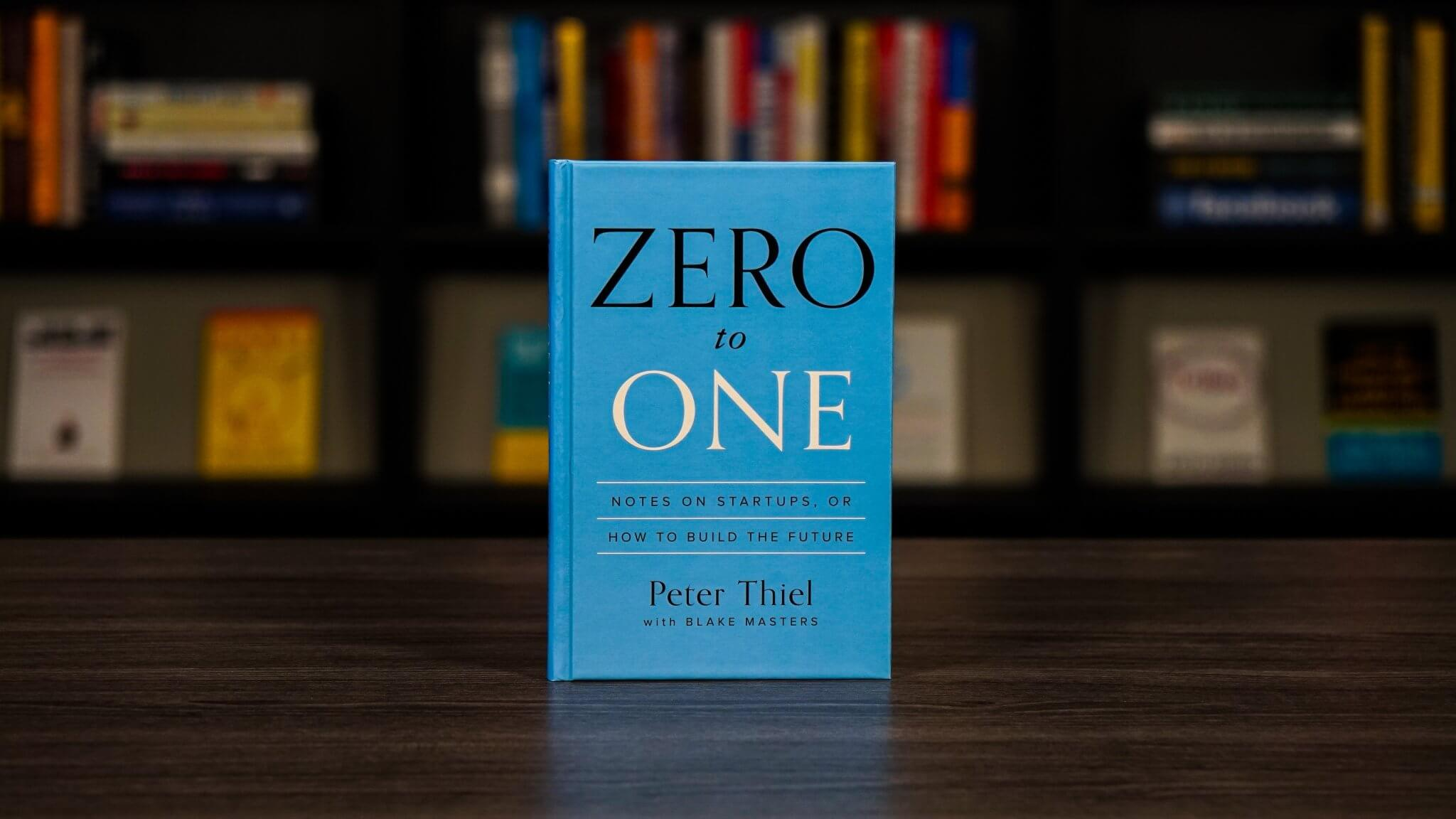
The term “zero to one” was popularized by PayPal co-founder Peter Thiel, first in his Stanford class CS183B: Startups, then eventually as a book published with one of his students in the class, Blake Masters, who shared his notes from the class in a Tumblr blog. They titled it Zero to One: Notes on Startups, or How to Build the Future.
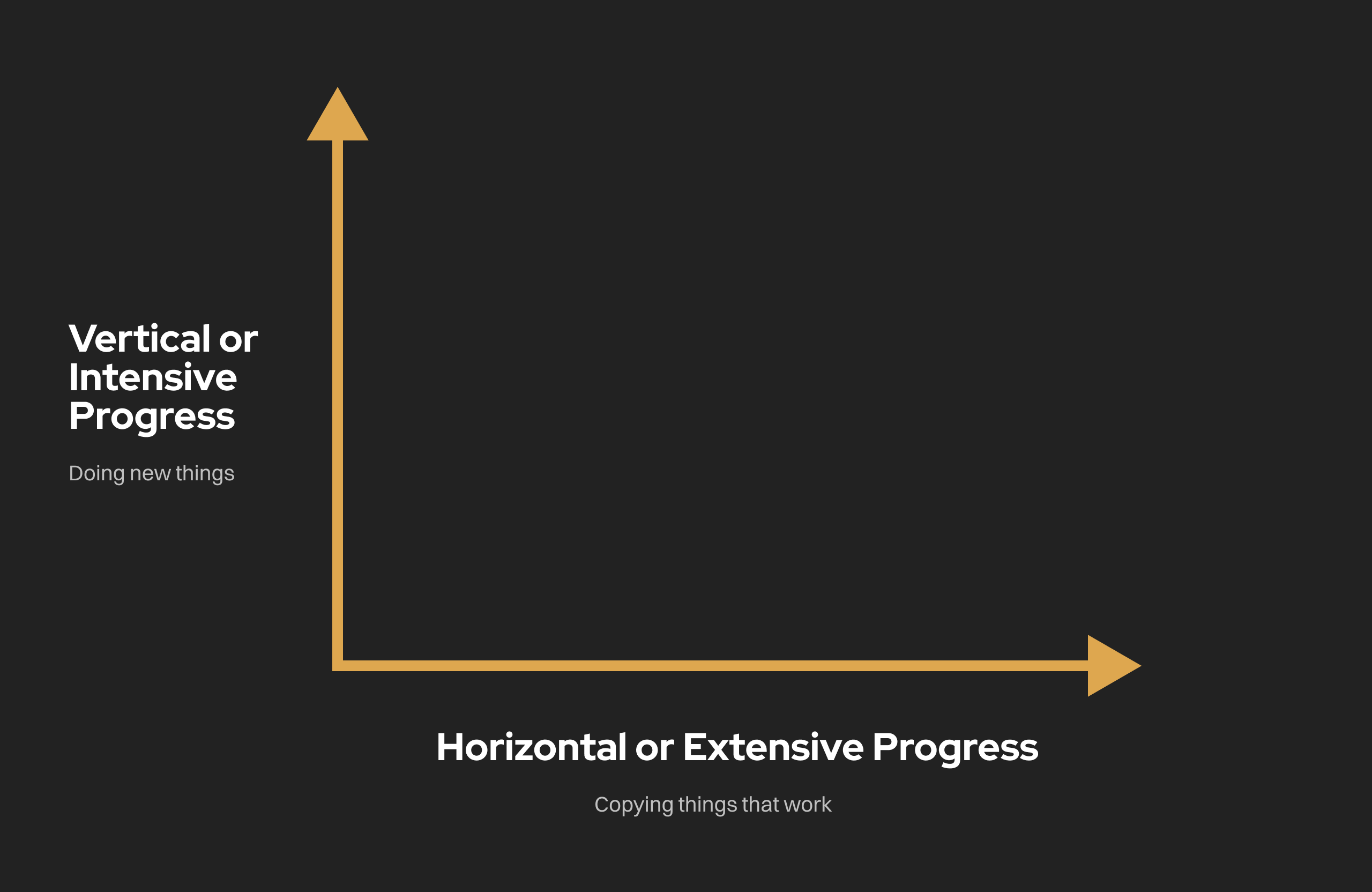
To go from zero to one means to produce vertical or intensive progress. To create entirely new things, new markets, new systems, a new way of doing things that were not seen or done before.
To quote Thiel:
Vertical or intensive progress means doing new things—going from 0 to 1. Vertical progress is harder to imagine because it requires doing something nobody else has ever done. If you take one typewriter and build 100, you have made horizontal progress. If you have a typewriter and build a word processor, you have made vertical progress.
It's the opposite of one of n, or horizontal progress, which is copying things that we know already work. He calls horizontal progress “globalization”—taking things that work somewhere work elsewhere, and vertical progress “technology” which is a new and better way of doing things.
This zero to one idea is spurred by the contrarian question: What important truth do very few people agree with you on?
Thiel likes this question because it's intellectually and psychologically difficult: it must be something that's not already agreed upon and be something that's known to be unpopular. A good answer to this question is what he believes can actually change the future in a way that's rooted in today's world.
This is important because philosophically, Thiel considers technological progress as a moral imperative, a way to prevent destruction because globalization is unsustainable.
He makes a case that startups have the best chance of changing the world for the better (and uses the Founding Fathers of the United States and the Traitorous Eight of Silicon Valley as examples).
The reason is because: 1) they are bound together by a sense of mission, and 2) it's too hard and too slow to do in large organizations or by yourself. Bureaucracies move too slow, are risk-averse, and it's common to signal that work is being done for the sake of career advancement while not actually moving the needle in any meaningful way. Whereas in startups, you can move quick, and most importantly, you can think:
Positively defined, a startup is the largest group of people you can convince of a plan to build a different future. A new company’s most important strength is new thinking: even more important than nimbleness, small size affords space to think.
Thiel, having been the CEO of PayPal, observed that after the dot-com bubble there were some lessons that ended up becoming dogma in Silicon Valley:
But he argues that the opposite of these principles are probably more correct:
These become the foundational tactics in the book.
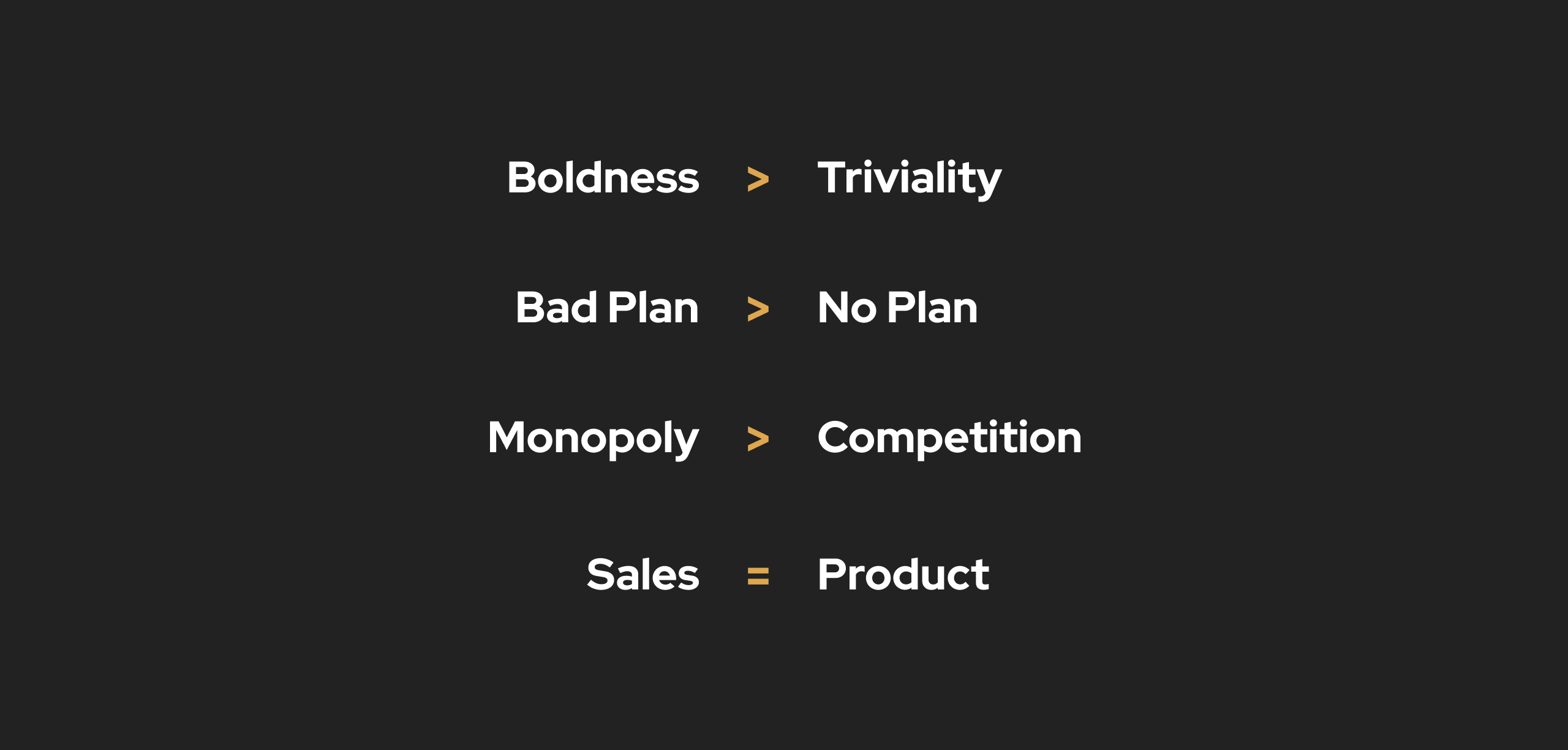
The business version of the contrarian question is, "What valuable company is nobody building?"
This is important because building a valuable company means you not only create value; you must also capture value in return. And truly valuable companies are not building undifferentiated businesses which charge what the market determines.
Rather, the truly valuable companies are monopolies—so good at what they do that no other company can offer a substitute. Because they are unique, they can set the price and can command outsized profits.
Thiel uses this as a central point: that monopoly is the opposite of competition, because under perfect competition, all profits get competed away:
The lesson for entrepreneurs is clear: if you want to create and capture lasting value, don’t build an undifferentiated commodity business.

Thiel goes a step further to state that competitive businesses have a problem beyond loss of profits—that to survive, they push people toward ruthlessness. Therefore, becoming a monopoly business isn't just necessary for survival, it's the only way for companies to be able to think long-term:
In business, money is either an important thing or it is everything. Monopolists can afford to think about things other than making money; non-monopolists can’t. In perfect competition, a business is so focused on today’s margins that it can’t possibly plan for a long-term future.
Only one thing can allow a business to transcend the daily brute struggle for survival: monopoly profits.
He argues that creative monopolies—those that create new products that benefit everybody and sustainable profits for the creator—are incentivized to drive progress because they can can command years if not decades of monopoly progress. And they can keep innovating because they have profits that enable them to make long-term plans and finance ambitious research. To take it a step further, Thiel states:
...every business is successful exactly to the extent that it does something others cannot. Monopoly is therefore not a pathology or an exception. Monopoly is the condition of every successful business.
He summarizes the monopoly vs. competition dichotomy as such:
All happy companies are different: each one earns a monopoly by solving a unique problem. All failed companies are the same: they failed to escape competition.
Great companies are not just about becoming a monopoly but staying one, and that means that it needs to generate cash flows in the future. Thiel emphasizes this because he thinks there is a "measurement mania" on short-term metrics; people remember growth but miss the second piece: endure.
There's nothing inherently wrong with targets but he argues that they can make someone miss the most important question you should be asking:
Will this business still be around a decade from now?
He argues that numbers alone won't tell the story; it's about the qualitative characteristics of the business—what makes it a monopoly.
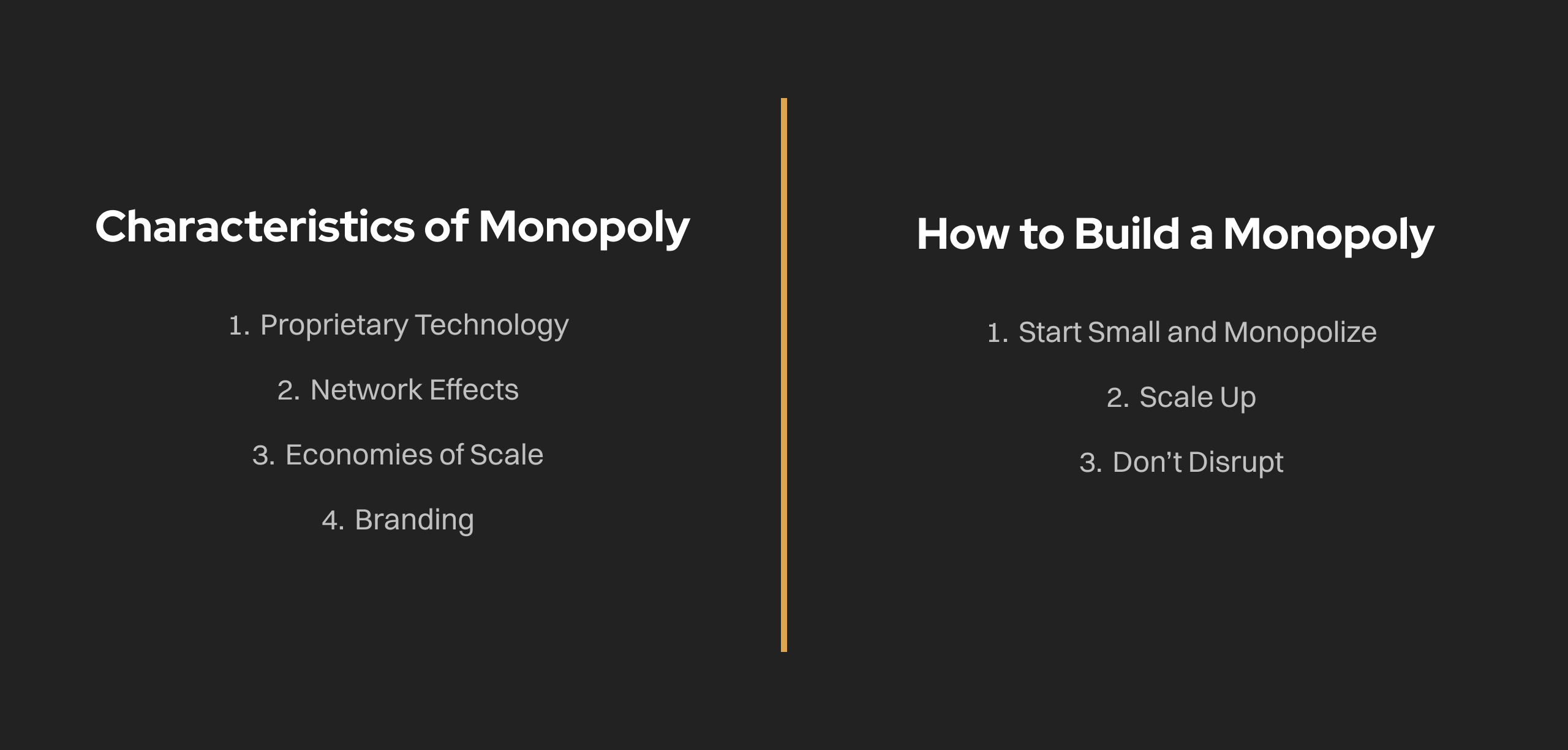
For a company to endure and generate cash flows in the future, they need at least or ideally a combination of these:
Meta (formerly Facebook) demonstrates how network effects can create an unassailable monopoly position. The more people joined, the more valuable it became for others to join, creating the kind of virtuous cycle Thiel identifies as crucial for monopolies. Their acquisition strategy (Instagram, WhatsApp) showed deep understanding of how to maintain monopolistic positions in social networking as technology evolved.
Characteristics of a monopoly matter, but to get them to work, you need to choose the market carefully and expand deliberately.
Is the future a matter of chance or by design? Thiel advices to think of the future as something that ought to be influenced rather than something that is indefinite and randomly uncertain.
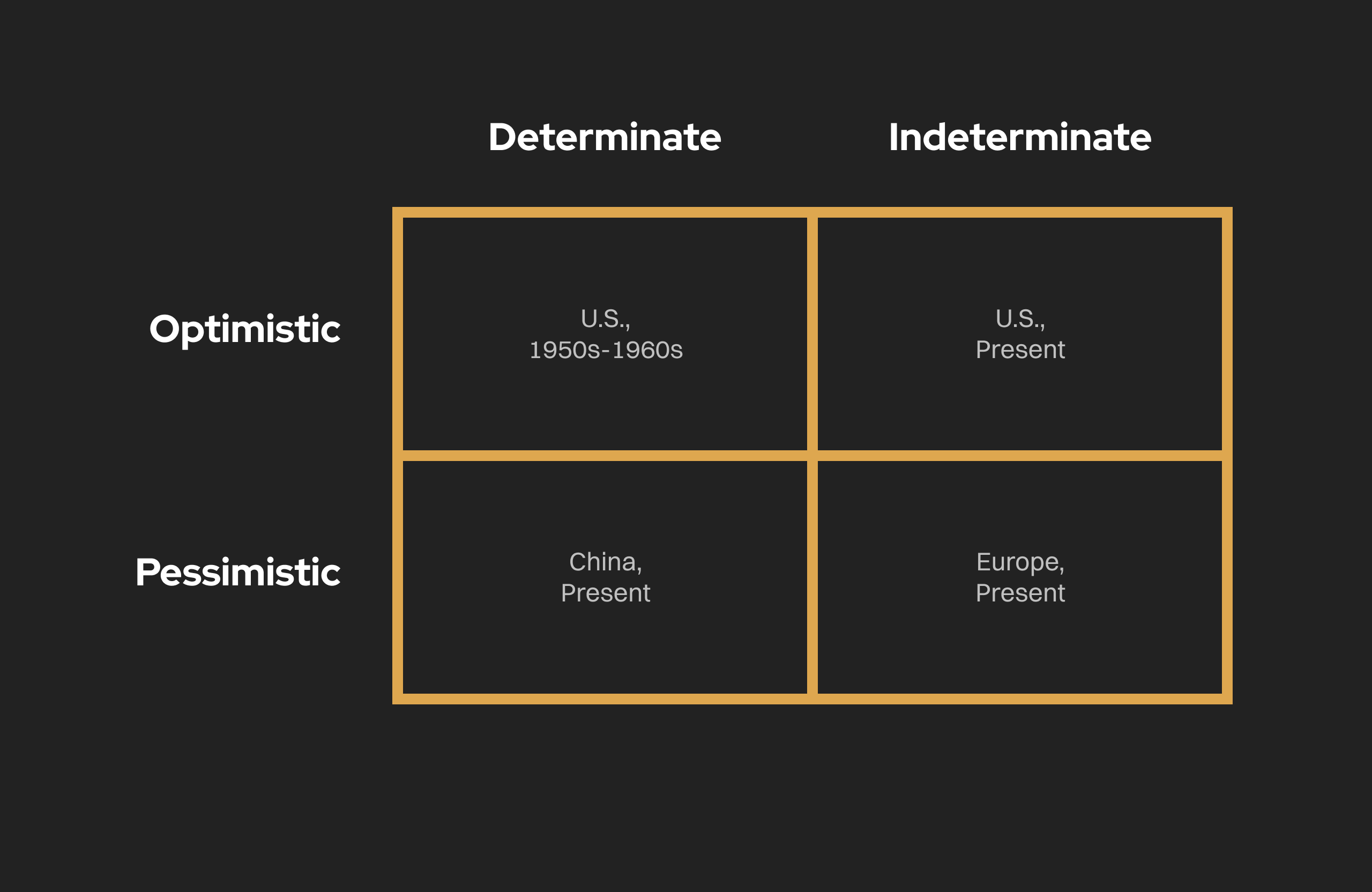
In Thiel's view:
...a definite person determines the one best thing to do and does it. Instead of working tirelessly to make herself indistinguishable, she strives to be great at something substantive—to be a monopoly of one. This is not what young people do today, because everyone around them has long since lost faith in a definite world.
Thiel breaks this down into a 2x2 matrix. Starting from the bottom left:
Every great entrepreneur is first and foremost a designer. To Thiel, the most important lesson from Steve Jobs has nothing to do with his aesthetics, but everything to do with his business—“Apple imagined and executed definite multiyear plans to create new products and distribute them effectively.” And he did this through careful planning and not by listening to focus groups or copying others' successes.
Long-term planning is often undervalued in our short-term world.
Thiel ends this chapter with this banger:
A startup is the largest endeavor over which you can have definite mastery. You can have agency not just over your own life, but over a small and important part of the world. It begins by rejecting the unjust tyranny of Chance. You are not a lottery ticket.
There are two main points of this chapter: 1) never underestimate exponential growth, and 2) we don't live in a normal world; we live under a power law. To contextualize this for startups: monopoly businesses capture more value than millions of undifferentiated competitors.
Thiel explains how the power law is underestimated even in venture, a business built entirely on finding outliers. The general thinking is that venture returns are normally distributed—bad companies fail, mediocre ones flail, and good ones return 2x or 4x, when instead it follows a power law: a small handful of companies radically outperform all others.
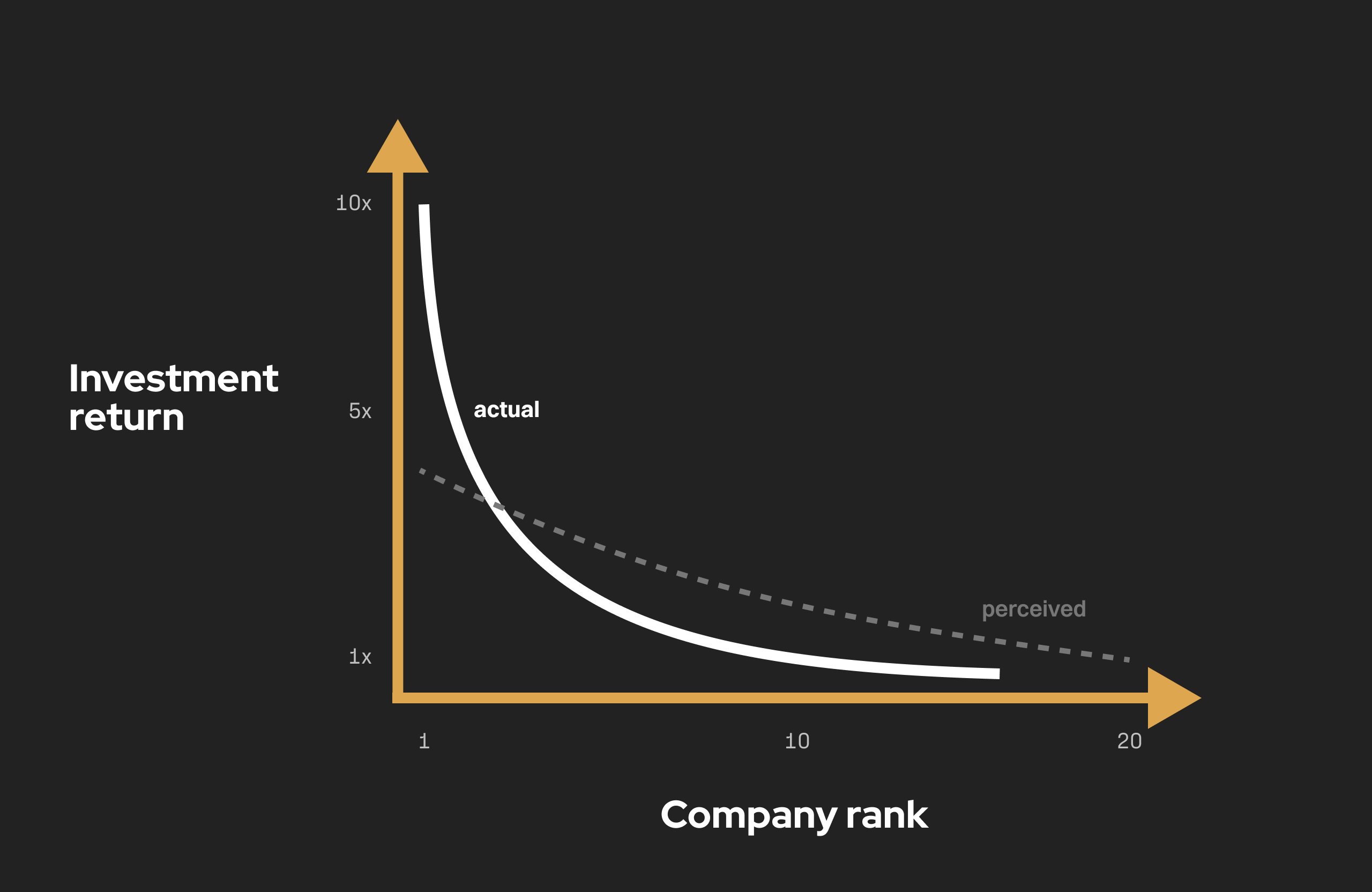
He argues that this is a mistake: that focusing on diversification instead of a single-minded pursuit of the very few companies that can be overwhelmingly valuable will make you miss the rare companies in the first place.
What this means for venture capitalists:
Every single company in a good venture portfolio must have the potential to succeed at vast scale. [...] Once you think you're playing the lottery, you've already psychologically prepared yourself to lose.
To bring this point home, Thiel contextualizes the power law isn't just for investors, but it's important to everybody because everybody is an investor: choosing a career is acting on a belief that the kind of work you do will be valuable decades from now.
He's against diversified portfolios of any kind that follow the sentiment “Don't put all your eggs in one basket.” Even the best investors have a portfolio, but investors who understand the power law make as few investments as possible.
He doubles-down on this:
But life is not a portfolio: not for a startup, and not for any individual. An entrepreneur cannot “diversify” herself: you cannot run dozens of companies at the same time and then hope that one of them works out well. Less obvious but just as important, an individual cannot diversify his own life by keeping dozens of equally possible careers ready in reserve.
[...] It does matter what you do. You should focus relentlessly on something you're good at doing, but before that you must think hard about whether it will be valuable in the future.
And contrary to what most people think about this book, Thiel is actually against the idea that there should be more companies that are started exactly because the power law goes against it:
For the startup world, this means you should not necessarily start your own company, even if you are extraordinarily talented. If anything, too many people are starting their own companies today. People who understand the power law will hesitate more than others when it comes to founding a new venture: they know how tremendously successful they could become by joining the very best company while it's growing fast. The power law means that differences between companies will draft the differences in roles inside companies.
However, for the brave few who do start companies, the advice of the power law remains: that most important things are singular — one market will probably be better than others, one distribution strategy dominates all others, and some moments matter far more than others:
What's most important is rarely obvious. It might even be a secret.
One of the main points of the entire book is that every one of today's ideas was once unknown and unsuspected. Conventional truths may be important, but they won't give you an edge, because it's not a secret.
Returning to the business version of the contrarian question—what valuable company is nobody building?—Thiel argues that every correct answer is necessarily a secret: something important and unknown, something hard to do but doable.
If there are many secrets left in the world, there are probably many world-changing companies yet to be started.
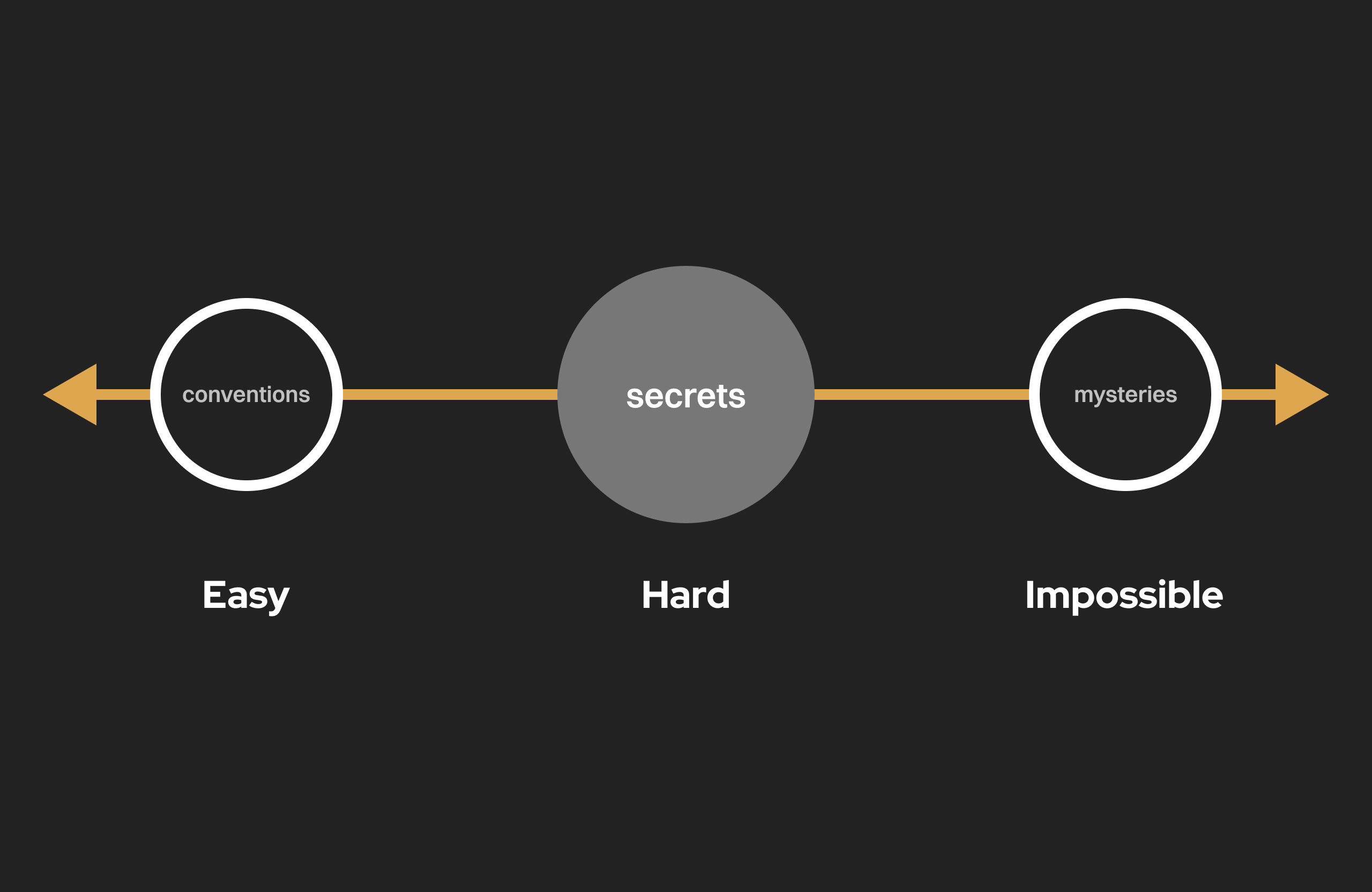
Aside from the fact that there are no longer blank spaces on the map, there are four social trends that have rooted out belief in secrets:
Thiel pushes that secrets will only be found by those who look for them and by believe they are possible in the first place. Believing that secrets exist is an effective truth all in itself:
The actual truth is that there are many more secrets left to find, but they will yield only to relentless searchers. There is more to do in science, in medicine, engineering, and in technology of all kinds. […] But we will never learn any of these secrets unless we demand to know them and force ourselves to look.
The same is true of business. Great companies can be built on open but unsuspected secrets about how the world works... only by believing in and looking for secrets could you see beyond the convention to an opportunity hidden in plain sight.
When thinking about what kind of company to build, there are two distinct questions to ask:
Thiel argues it's easy to assume that natural secrets are the most important as the people who look for them can sound intimidatingly authoritative. But it's actually secrets about people that are relatively under-appreciated: What are people not allowed to talk about? What is forbidden or taboo?
To take this a step further, one could ask: What are people running companies not allowed to say?
The best place to look for secrets is where no one else is looking. So you might ask: are there fields that matter but haven't been standardized and institutionalized? It won't be easy, but it's not obviously impossible: exactly the kind of field that could yield secrets.
This is where Thiel connects the dots between secrets and startups:
So who do you tell (a secret)? In practice, there's always a golden mean between telling nobody and telling everybody—and that's a company. The best entrepreneurs know this: every great business is built around a secret that's hidden from the outside. A great company is a conspiracy to change the world; when you share your secret, the recipient becomes a fellow conspirator.
He summarizes this: Take the hidden paths.
This chapter covers the dynamics of a company within its own walls, namely, its culture. Thiel is vehemently against the caricature of what typical Silicon Valley companies have become: outrageous perks, interior decorators beautifying the office, human resource consultants to fix policies, and branding specialists to hone on buzzwords. Thiel defines company culture as such:
“Company culture” doesn't exist apart from the company itself: no company has a culture; every company is a culture. A startup is a team of people on a mission, and a good culture is just what that looks on the inside.
Thiel maintains that relationships are the most important part of a company. He rejects the idea of people working together who don't even like each other, and despises the idea of free agents checking in and out purely on a transactional basis, and argues it as irrational:
Since time is your most valuable asset, it's odd to spend it on working with people who don't envision any long-term future together. If you can't count durable relationships among the fruits of your time at work, you haven't invested your time well—even in purely financial terms.
At PayPal, he believed that tightly knit companies built on strong relationships would make people not just happier and better at their jobs but also more successful in their careers beyond PayPal. In hiring, they sought candidates who were talented, but more importantly, had to be excited about working specifically with them.
Thiel argues that recruiting is a core competency for any company, and as such, should never be outsourced. And because talented people don't need to work for you because they have plenty of options, companies should have a reason why someone would join their company when they could work elsewhere for more money and prestige.
Bad reasons are things like valuable, stock, smart people, and pressing problems, because every company makes these same claims. The good answers are specific to the company. But two general kinds of good answers are answers about your mission and answers about your team.
You'll attract the employees you need if you can explain why your mission is compelling: not why it's important in general, but why you're doing something important that no one else is going to get done.
That said, a great mission is not enough. The recruit who would be most engaged will also wonder, “Are these the kind of people I want to work with?” and you should be able to explain why your company is a unique match for them personally. And if you can't do that, then they're probably not the right match.
Lastly, if you have to fight for perks, they would be a bad addition to the team. After covering the basics like health insurance, the most you can do is promise what no one else can: the opportunity to do irreplaceable work on a unique problem alongside great people.
Thiel believes that from the outside, everyone in your company should be different in the same way, and his co-founder at PayPal Max Levchin extends this believe that startups should make their early staff as personally similar as possible.
Startups have limited resources and small teams. They must work quickly and efficiently in order to survive, and that's easier to do when everyone share an understanding of the world.
This is an argument not about being similar in how you look or any other superficial dimension. It's about having a similar point of view of how the world ought to be, and equally obsessed about similar things.
There are intense kind of organizations with members who experience strong feelings of belonging and get access to esoteric “truths” denied to ordinary people—these are called cults. The extreme opposite of a cult is a consulting firm like Accenture which lacks a distinctive mission and consultants regularly drop in and out companies without any long-term connection.
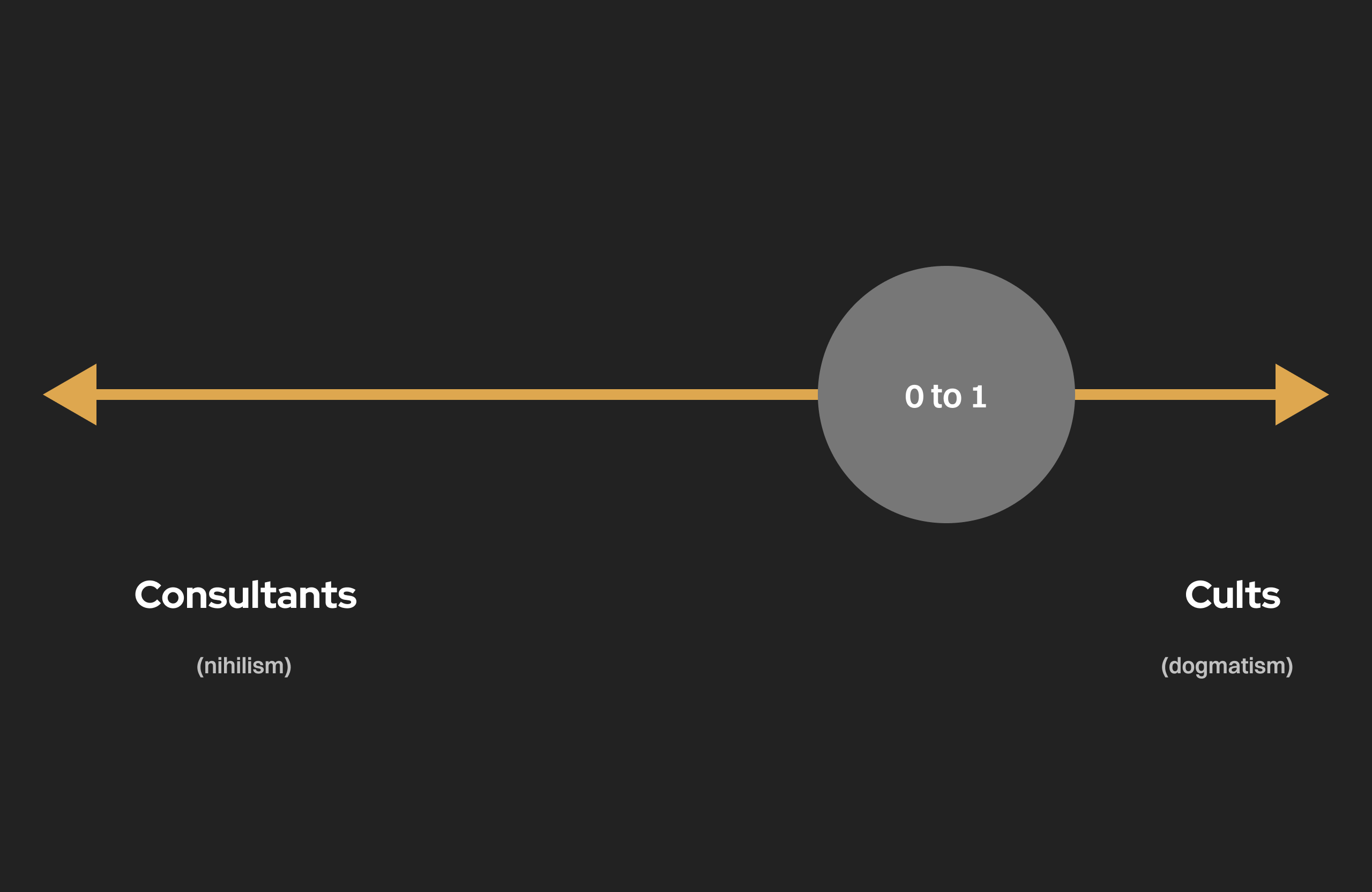
Thiel argues that the best startups might be considered slightly less than the extreme kinds of cults. The difference is cults tend to be fanatically wrong about something important, whereas people at a successful startup are fanatically right about something those outside have missed.
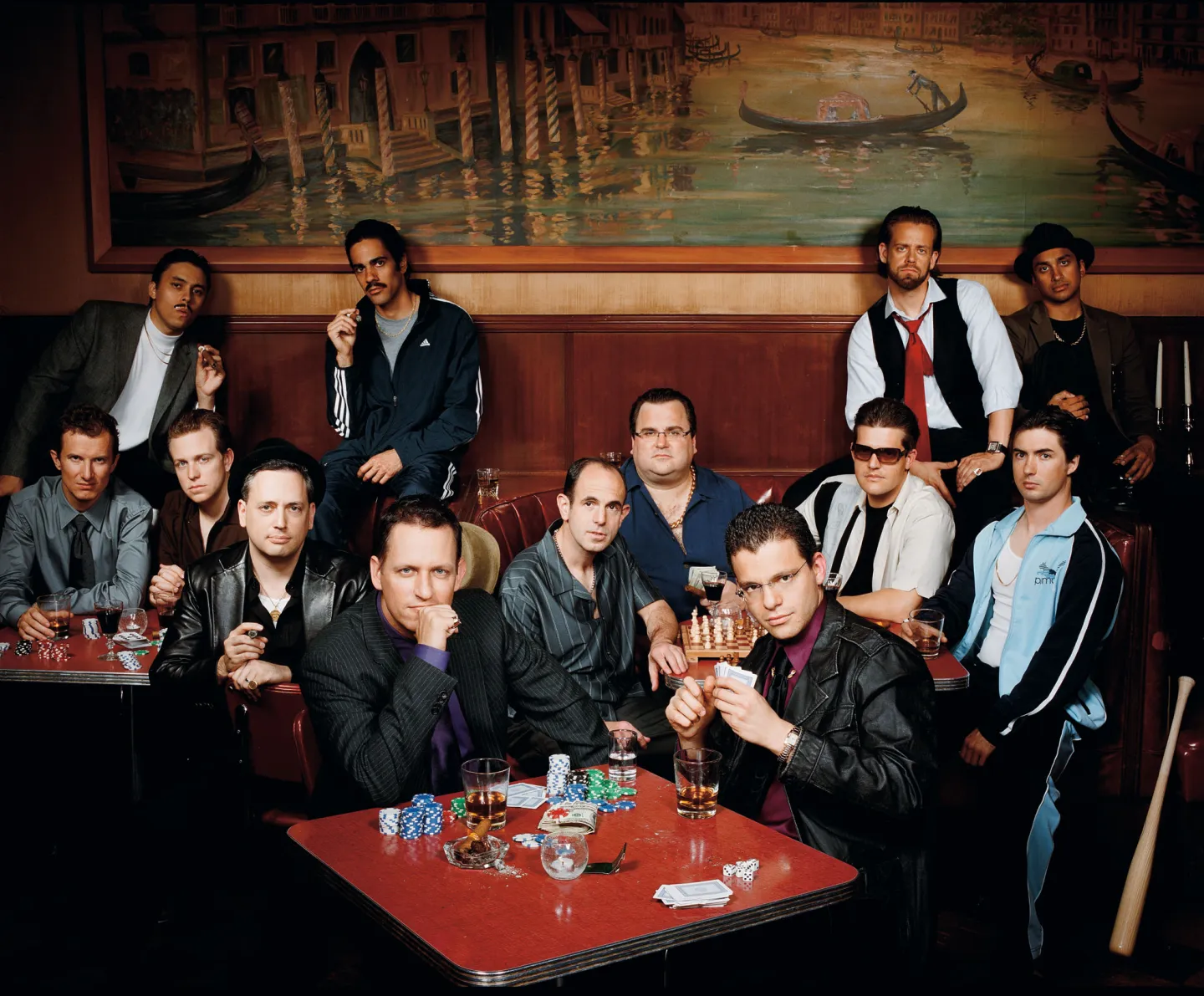
This means that you don't need to worry if your company doesn't make sense to conventional professionals. It's better to be called a cult—or even a mafia.
The short answer is no. Thiel argues that technology companies severely underestimate the importance of distribution—the catchall term for everything it takes to sell a product. Even businesspeople underestimate the importance of sales, because there is a systematic effort to hide it at every level of every field in a world secretly driven by it.
Instead of making companies solely about a product so great it sells itself, he argues that “it's better to think of distribution as something essential to the design of your product:”
If you've invented something new but you haven't invented an effective way to sell it, you have a bad business—no matter how good the product.
He starts this section with a banger that most people would be uncomfortable to admit:
Superior sales and distribution by itself can create a monopoly, even with no product differentiation. The converse is not true.
There are two metrics that set limits for effective distribution: the total net profit you earn on average over the course of your relationship with a customer (Lifetime Value or LTV) must exceed the amount you spend on average to acquire a new customer (Customer Acquisition Cost or CAC). In general, the higher the price of your product, the more you have to spend to make a sale and the more it makes sense to spend it.
There is a continuum for sales at a company.
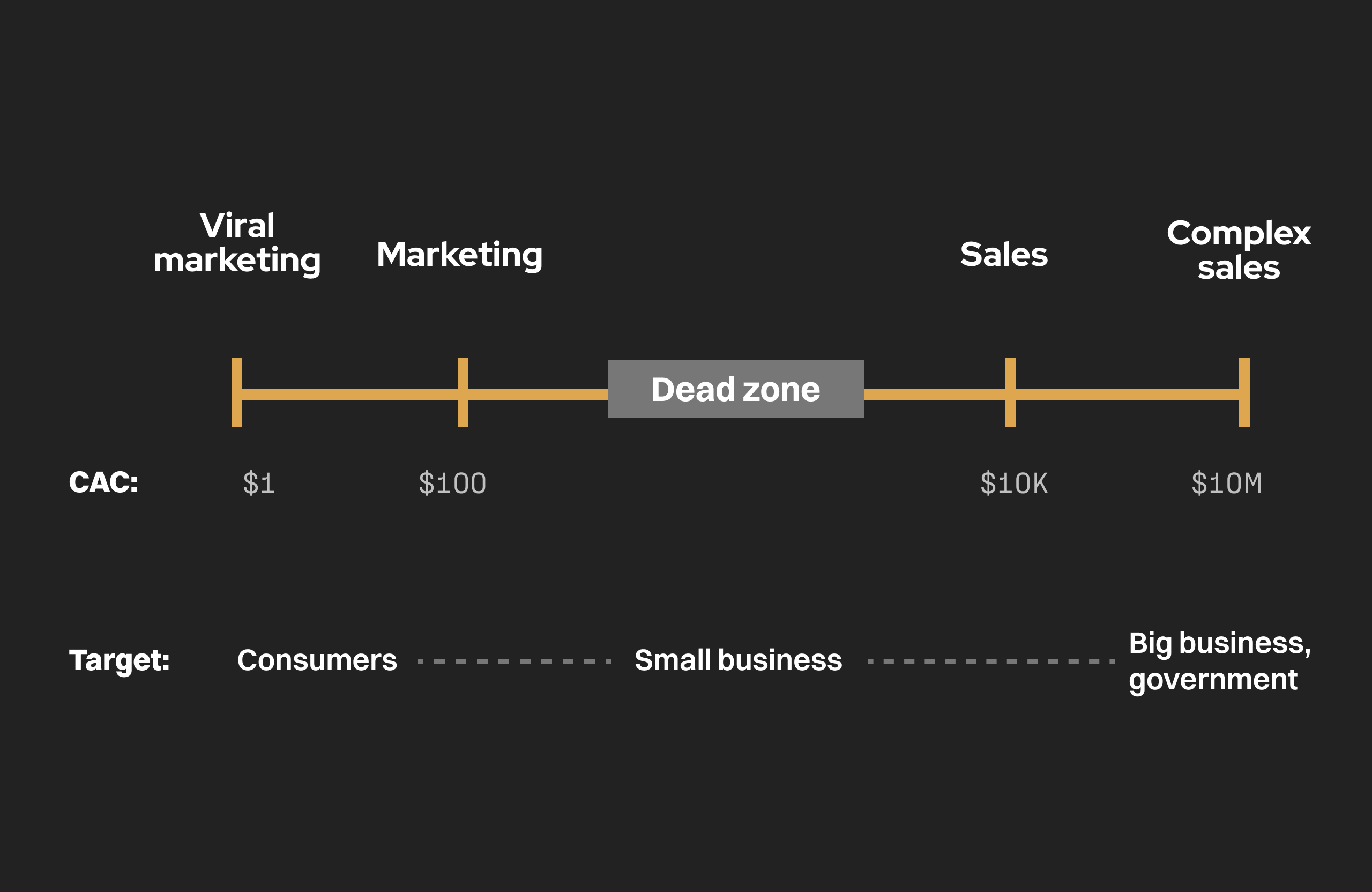
Just like anything, distribution follows a power law of its own: one of these methods is likely to be more powerful than every other combined for any given business. This is counterintuitive for most entrepreneurs who assume that more is more, when in truth, the kitchen sink approach doesn't work.
Most businesses get zero distribution channels to work: poor sales rather than bad product is the most common cause of failure. If you can just get one distribution channel to work, you have a great business. If you try for several but don't nail one, you're finished.
Thiel ends this chapter with a quip:
Everybody has a product to sell—no matter whether you're an employee, a founder, or an investor. It's true even if your company consists of just you and your computer. Look around. If you don't see any salespeople, you're the salesperson.
This chapter may be more nascent in 2024 than when the book was published in 2014. Thiel argues that technology is not meant to be seen as a rival, but as a tool. And the ones who use technology to empower people, and not replace them, are the ones that will build great businesses.
Computers are complements for humans, not substitutes. The most valuable businesses in the coming decades will be built by entrepreneurs who seek to empower people rather than try to make them obsolete.
Thiel argues that using technology over globalization is a more compelling way of creating value. This is because people don't just compete in the labor market, they also compete for similar resources. If technology is used properly, all the value accrues to humans, without competing for the same resources they do. Thus, humans and computers don't have to compete because they are categorically different in what they do as they are good at fundamentally different things:
People have intentionality—we form plans and make decisions in complicated situations. We're less good at making sense of enormous amounts of data. Computers are exactly the opposite: they excel at efficient data processing, but they struggle to make basic judgments that would be simple for any human.
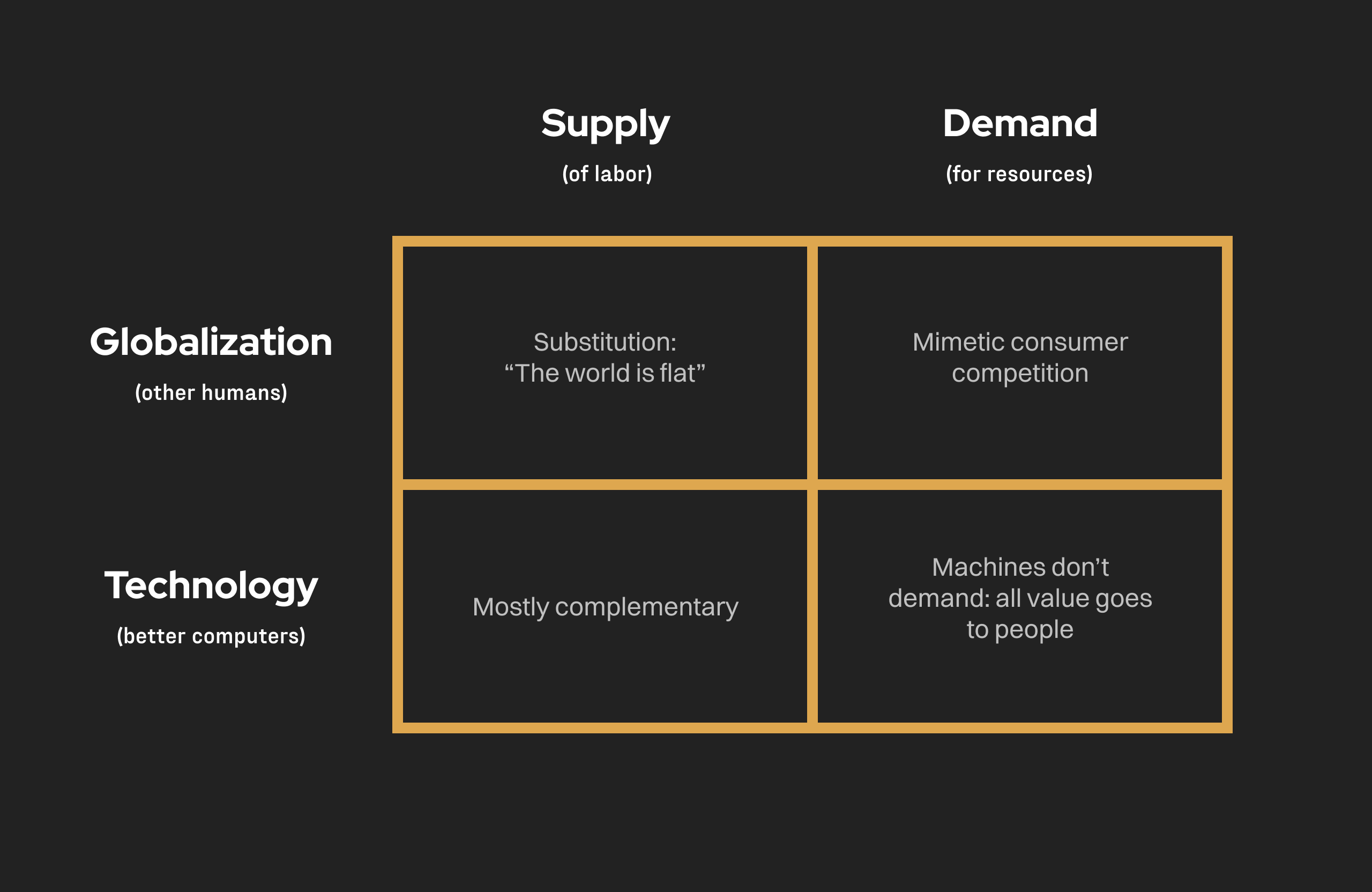
Thiel makes the case that outsourcing the more manual data processing tasks to computers gives room for humans to focus on what they're uniquely good at. To think of humans as purely widgets that compete against technology is to place humans in the lowest common denominator.
A thought exercise that Thiel wondered about after they sold PayPal is the man-machine solution: “if humans and computers together could achieve dramatically better results than either could attain alone, what other valuable businesses could be built on this core principle?”
Computers can find patterns but ultimately, they can't interpret complex behaviors and he argues that actionable insights can only come from a human analyst. Even with more advanced technology in 2024 than we have in 2014, I agree with this premise. The technology may be more powerful and smarter, but so long as computers can't take responsibility and imagine for themselves without a prompt, they can't ultimately replace humans. His business conclusion to this is:
The most valuable companies in the future won't ask what problems can be solved with computers alone. Instead, they'll ask: how can computers help humans solve hard problems?
Thiel argues that “Strong AI” or computers that eclipse humans in every important dimension is a problem for the 22nd century. He says that even if it was possible, that indefinite fears about the far future shouldn't stop us from making definite plans today.
There are extreme beliefs on both sides — Luddites on one end that we shouldn't build the computers that might replace us, and crazed futurists that argue we should. He argues that these two positions are mutually exclusive but are not exhaustive:
...there is room in between for sane people to build a vastly better world in the decades ahead. As we find new ways to use computers, they won't just get better at the kinds of things people already do; they'll help us do what was previously unimaginable.
The next chapter is really about why cleantech didn't work in the 2010s analyzed through the seven questions asked in Zero to One. Thiel uses these questions as a filter that every business must answer:
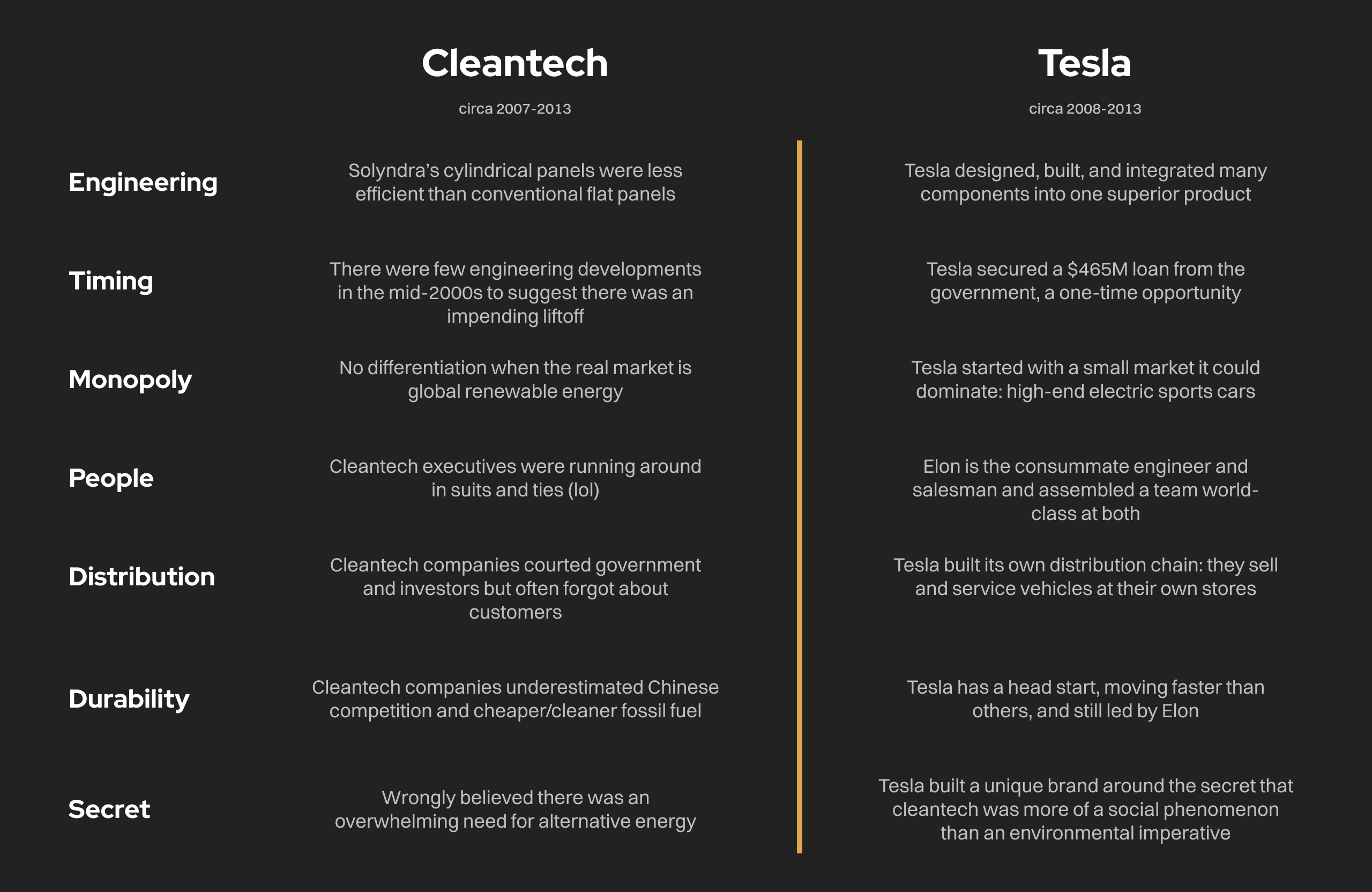
Because Feel Eternity also thinks about philosophy, this is one of my favorite sections in the book. Thiel holds the position that, “social entrepreneurs aim to combine the best of both worlds (for-profit motive and non-profit interest) and ‘do well by doing good.’ Usually they end up doing neither.” He argues that “Whatever is good enough to receive applause from all audiences can only be conventional.”
If trying to tiptoe this line and be ambiguous isn't good for society, Thiel counters it back to the singular question:
Doing something different is what's truly good for society—and it's also what allows a business to profit by monopolizing a new market. The best projects are likely to be overlooked, not trumpeted by a crowd; the best problems to work on are often the ones nobody else even tries to solve.
The chapter covers why Thiel believes it's more powerful but at the same time more dangerous for a company to be led by a distinctive individual instead of an interchangeable manager.
First, Thiel argues that most people who become successful founders aren't just fat-tailed in a normal distribution of traits, which feels like the more intuitive way to think of these kinds of people in comparison with the general population. He argues that the founder distribution are simultaneously insiders and outsiders, and when they do succeed, they attract both fame and infamy. The distribution is actually convex—they are usually an extreme combination of both sides.
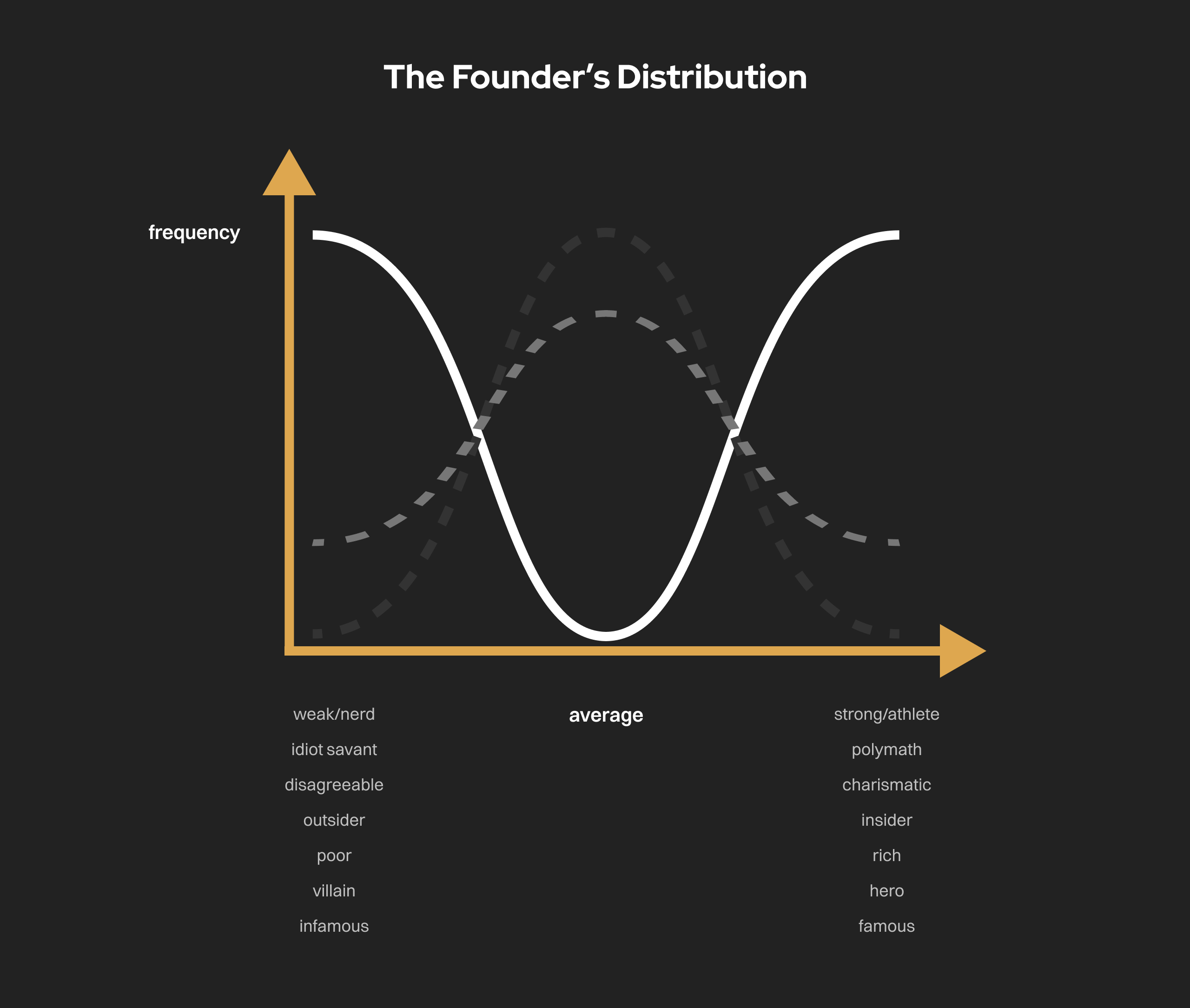
Are they actually extreme as they seem? Do they exaggerate their own characteristics? Is it possible that everyone else exaggerates them? Instead of saying these things are exclusive, Thiel argues that they can all exist at the same time. Being actually different can lead to developing extreme traits, which can lead to them exaggerating these traits, which lead to others exaggerating them, making them actually different—a positive feedback loop that can reinforce each other.
Because of this extreme persona, Thiel makes a point that founders make for an effective scapegoat: on one hand, they are powerless to stop their own victimization; on the other hand, as the one who can defuse conflict by taking the blame, they are the most powerful member of the community. Thiel captures this with a thought: “Perhaps every modern king is just a scapegoat who has managed to delay his own execution.”
Thiel illustrates this dichotomy by using Steve Jobs who founded Apple, got kicked out by his own board of directors, only to be asked to come back and eventually turn it from a failing company into the most valuable company in the world (as of this writing, is still accurate 10 years after the publishing of Zero to One, with a market cap of $3.3 trillion).
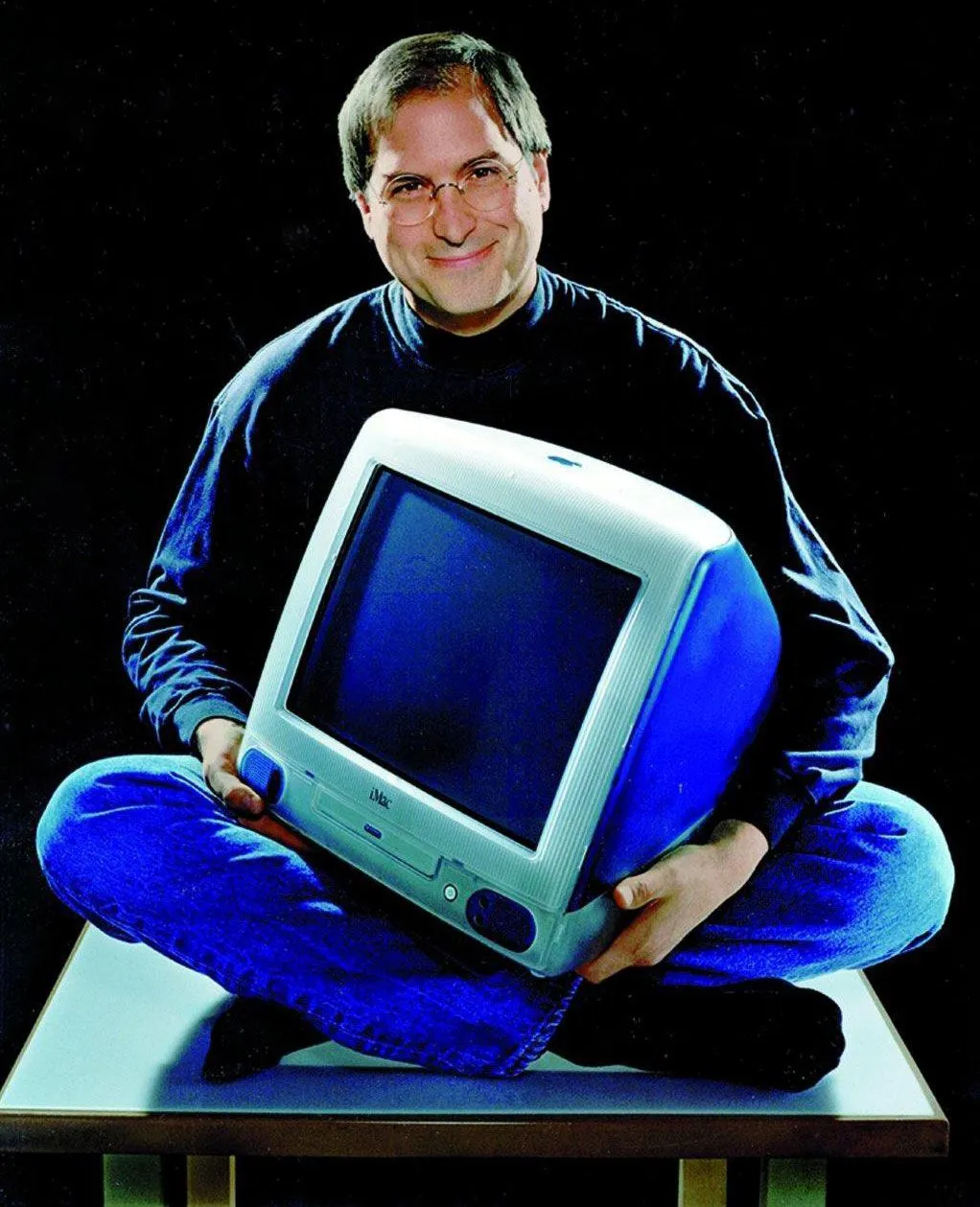
Thiel's argument is that Jobs' return signifies something in companies that create new technologies: that they resemble feudal monarchies rather than organizations that are supposedly modern. A unique founder:
Thiel encapsulates his point:
The lesson for business is that we need founders. If anything, we should be more tolerant of founders who seem strange or extreme; we need unusual individuals to lead companies beyond mere incrementalism.
The lesson for founders is that individual prominence and adulation can never be enjoyed except on the condition that it may be exchanged for individual notoriety and demonization at any moment—so be careful.
Thiel summarizes the four possible futures of humanity as written by philosopher Nick Bostrom:
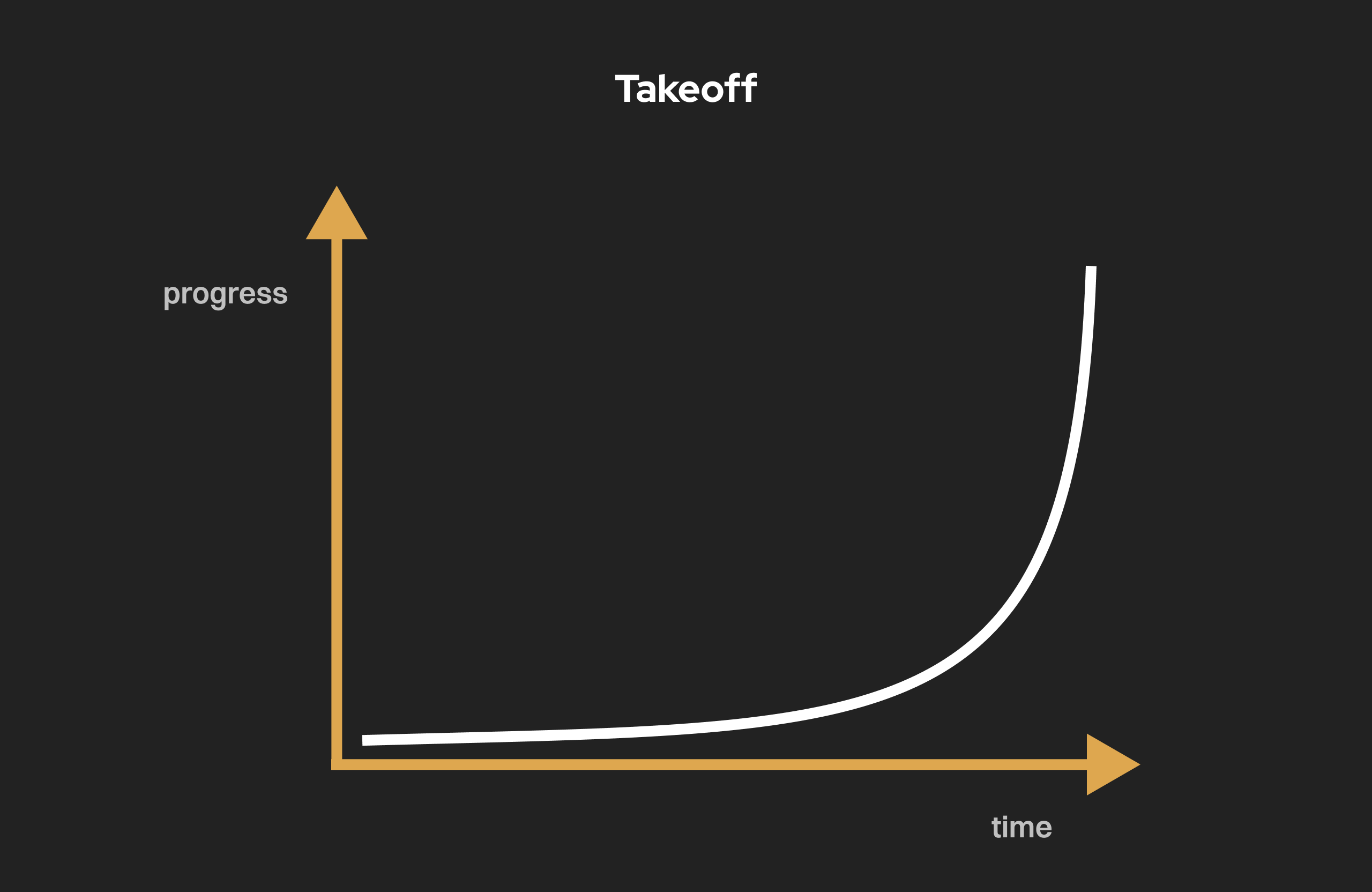
He evaluates each one and argues against the first three, and especially warns against stagnation as it collapse into extinction. He argues the only way out is the fourth scenario in which we create new technology to make a much better future. The most dramatic version of this outcome is the Singularity, a future so powerful that it transcends the limits of our own understanding. Thiel ends with this thought:
The future won't happen on its own. What the Singularity looks like matters less than the stark choice we face today between the two most likely scenarios: nothing or something. It's up to us. We cannot take for granted that the future will be better, and that means we need to work to create it today.
[...] Our task is to find ways to create the new things that will make the future not just different, but better—to go from 0 to 1. The essential first step is to think for yourself. Only by seeing the world as as anew, as fresh and strange as it was to the ancients who saw it first, can we re-create it and preserve it for the future.
Zero to One is a compelling book from a controversial author. No matter one's opinion on Thiel and his politics, it's hard to deny that he practices what he preaches: rejection of conventional beliefs and long-term execution of plans.
He has the track record to back it, through the founding of PayPal and Palantir, being the first outside investor in Facebook, and Founders Fund having a portfolio that boasts investments in SpaceX, DeepMind, Airbnb, and Stripe among others. Outside of business, in a huge surprise at the time, he publicly backed Donald Trump who eventually won the 2016 election, and used $10M of his own money in legal expenses against Gawker, holding a decade-long vendetta against the gossip blog for publicly outing his sexuality, ultimately bankrupting the publication.
Ten years after Zero to One's publishing, the book has strongly held up, maybe even feels more prescient now that the artificial intelligence race is full steam ahead, Google facing an antitrust case with a federal judge labeling them a monopoly, and much of the tactics hold up such as starting small and monopolizing a market, sales being as important as product, and focusing on the singular things that create power laws.
My opinion of the book is that it's refreshing to read from the perspective of someone who has proven to be repeatedly successful go against conventional truths one by one. Thiel clearly explain himself in detail his thought process as to why it's not just wrong but why the converse may actually be more right. It's also filled with humorous jabs (comparing hipsters to The Unabomber, not funding anyone pitching in a suit and tie, and calling out how nerds discriminate against salesmen), and he doesn't hold back by name-checking people and companies directly.
He doesn't say it directly, but may be the best part of this book is it's filled with references in literature (Tolstoy's Anna Karenina, Shakespeare's Romeo & Juliet, Douglas Adams' The Hitchhiker's Guide to the Galaxy, Tolkien's The Lord of the Rings) and his philosophy, as influenced by René Girard, around mimetic theory and the scapegoat mechanism. This is unconventional as far as business books typically go and they certainly don't go in-depth and esoteric the way he does, giving direct examples of how he operated his own startups in practice, while still grounding it in business terms and technological advancements.
For builders, these are the 10 most important takeaways I've found:
These are harder to do in practice. But Zero to One offers a strong roadmap for how to build the future. In Grandmaster Jose Raul Capablanca's words:
You must study the endgame before everything else.
♾️

I feel like I’ve just unlocked something monumental regarding my own relationship with anxiety.
I was reading The Courage to Create, a book published in 1975 by existential psychologist Rollo May and it introduced a powerful framing of anxiety that I hadn’t considered before but is potentially life-changing. I guess we’ll see.
I’ve felt different kinds of anxiety all my life. But there is one type which I was struggling to pinpoint, explain, and put into words. I knew it was different because it has especially been crippling the past few years of my life. I feel bouts of inexplicable emptiness, sadness, and oftentimes meaninglessness, which if you know me personally, might sound surprising because I can come off as a deeply engaged and passionate person full of joie de vivre. But this feeling isn’t exactly new, I just felt it a lot more recently.
This type of anxiety has both been chronic, something I felt regularly, but also has caught by surprise, often when I least expect it, and sometimes even in the most bewildering times, like when things are actually going great in my life. It has been particularly troubling for me because by any standard of measure, I’ve never felt more blessed: I’m healthy, I love and am proud of what I do for a living, I feel like I’ve never been better and confident as a designer in my entire career, I have a wonderful partner I love and continue to grow with, I have a great place I live in with food and warmth never an issue, I’m surrounded by love from family and friends (should I choose to be surrounded by aforementioned love, which is another topic on its own). In short, I’m at a point in life where I feel I have everything I need.
And yet, there is a nagging feeling inside that was ravaging me from within. It was like a boogeyman that would arise from the night after a hard day’s work filled with joy, pride, and satisfaction. Bam. It would hit me, not like a speeding train but more like a slow moving truck that I was half-expecting to hit me and yet I still couldn’t move away from it. And it would send me in a spiral. And this lingering dread haunted me on a regular basis. And my defense mechanism would be to retract from the world, to distract myself so I would not feel this simmering pain, and I would be in my own head and pretend everything is okay, until I wake up the following day, and do the cycle over again. Now, I’d still do my regular habits and things would seem fine and I’d have a great day, but it would come back at night like clockwork.
What was deeply confusing for me was I do not recall feeling this particular anxiety this deeply when I had none of the things that I have now. Almost a decade ago I was struggling with where my future was headed, I did not have the same security I feel now, I didn’t have any money, access to food and warmth was not as easy, my relationships were not where they are today. I was still anxious then but that one felt clearer to me. It was an anxiety for survival: Am I going to make it out of my situation? Am I going to improve my life? Am I going to make something out of myself? But I did not have this feeling of emptiness that now feel despite having all the things I only dreamed of not long ago. By every definition, I should feel fulfilled, and yet I feel a deep void within me that I can’t quite put my finger on. What is it?
I hesitate to give it a name because I don’t think I’ve quite unlocked or understood it fully yet. But what I’m slowly discovering is what I feel deep down is perhaps an anxiety related to creativity, or lack thereof. Specifically, an anxiety felt because I haven’t been creating things that I felt allowed me to create meaning, an internal urge that is not related to any extrinsic reward or achievement at a job or anything else. This is purely related to a process of trying to create art for its own sake, to derive meaning out of life through one’s own lenses. In other words, I’ve been ignoring a calling I feel deep inside to try to carve out a “universality of meaning” through my own creativity.
This sounds really abstract but not for artists. Rollo May pointed out a study in which people where given Rorscach-like series of tests, and a group of “normal” people selected “the orderly, symmetrical cards as the designs they liked the most—they like their universe to be in shape.” The same test was given to “creative persons”—those who were recognized by their peers as having distinguished contributions to their field:
But the creative persons selected chaotic, disorderly cards—they found these to be more challenging and interesting. They could be like God in the Book of Genesis, creating order out of chaos. They chose the “broken” universe; they got joy out of encountering it and forming it into order. They could accept their anxiety and use it in molding their disorderly universe “closer to their heart’s desire.”
Reading “accept their anxiety” was a lightbulb moment for me. The anxiety I feel is directly tied to this immediate tension between being a particular kind of person and seeing chaos everywhere. And in that very moment of this realization, anxiety exists. This is not a new or special feeling. I’ve felt this since childhood. The differences was, even in moments where I felt I was fighting for my survival some years ago, I “accepted” this anxiety and did my best to create order out of chaos, to create meaning out of meaninglessness, despite my lack of skills and resources. I wasn’t as good nor was I equipped, and yet I still tried with all my might to create something—through writing, through design, through art. I tried to make sense of the world around me wrapped in emotion and vulnerability because I felt like I had nothing to lose and because it was a compulsion that I needed to address. In a sense, maybe it was my survival mechanism.
Whereas these days, I’ve thought of this creative process as a tradeoff—one where I am putting forward progress in my career, my job, my status, my finances in the back-burner should I choose to spend my finite time creating. I viewed it as costly because in logical terms, it didn’t add to the things I already had. It wasn’t an “investment” towards my future and creating had an “opportunity cost” to the things that I had to do.
But the real cost was I no longer felt alive. I felt pain I didn’t know how to cure. I have all these things that I didn’t have before that I can’t even enjoy because I knew something was missing deep down. I viewed this anxiety as something to get rid of, something to distract myself from, something to ignore, but it only came back to me, day after day, night after night, week after week, with a deep sense of dissatisfaction even when I have everything I could need.
This is when it occurred to me that this anxiety is actually a calling. That sounds absurd to read because how can crippling anxiety be seen as a calling? First, one doesn’t feel this particular anxiety if they don’t feel this tension between how the world is and how the world can be. This same compulsion to turn chaos into order feels like a curse because it is ever-present, it is not something one can just get rid of, and in a way, it may be something one can never fully satisfy themselves of. For some people—and I’m in this category—things can perpetually be better because things aren’t good enough. But more specifically, these kinds of people felt like they need to do something about it.
But in this exact moment of tension is where passion can come alive. Rollo May describes passion not as a “quantity of emotion” but rather a “quality of commitment”—it is precisely this openness and desire to confront the encounter that creates passion. You can’t confront the encounter between yourself and this moment of tension unless you first accept the anxiety. And you want to confront the encounter because it just might lead you to ecstasy—this heightened sense of consciousness, a “temporary transcending of the subject-object dichotomy.”
As much as it might feel like a curse, this is when it occurred to me that this particular anxiety can rather be a gift. It is an itch to be scratched, one that can only be relieved by accepting the anxiety, confronting the encounter, and having the courage to create something, to make something that was not there before, to create meaning out of meaninglessness, to hopefully reach ecstasy no matter how fleeting.
And this is only possible through the artist looking at themselves as a vessel, to allow themselves to be open and receptive to the things around them, to how they’re feeling, to the ebbs & flows of life, but to also have the courage to create not just to relieve themselves of this anxiety, but to make something out of it that hopefully contributes something new to the universe.

Radical love & radical gratitude for everything is a tough concept to understand.
We can’t possibly love and be grateful for everything that happens to us. Sure, we can love and be grateful for the good things in life, but it’s difficult to love and be grateful for every minor annoyance, for unsavory people, for difficult times, for traumatic experiences, for extreme hardships. And maybe we don’t have to. Not everything needs to have a positive spin on it. Sometimes shit is just bad.
Or can it be more?
In the thought exercise of radical love and gratitude, we might be able to radically accept things, situations, events, and people, and see things for what they plainly are. And through it, to see ourselves in the process as a totally separate and detached being from all of these. That we have our own reality, and our own person, and we are our own individual and it need not be consumed by everything else around us.
That through radical love and gratitude for everything, we might radically love ourselves and be grateful for our own lives, no matter what has happened in the past, what is happening in the present, and what might happen in the future.
To radically love and be grateful for all the things we don’t want to do, for people we encounter that we would rather wish to not be in our lives, for difficult challenges that send us to our brink. That it might be through these things that we can hope to find the things that we do want to do, find people we would love to spend time with, and find who we really are and what we are made of in our heart of hearts.
When there seems like there’s nothing to love and be grateful for, it challenges us to look around—literally look around—to your left, to your right, to your up, to your down, to breathe the air around you, the see the sights around you, to smell the smells around you, to hear the things around you.
To laugh at the absurdity of life and existence, to smile at all its pains and wonders, to cry at its surrealness and beauty. To absorb all of it, and be mesmerized by your very presence within it, as you play your own unique part in the vastness and history of the entire universe, without judgment, nor regret, nor attachment. Just as you are this very moment, you have already altered the shape of history and the depths of time.
It might be difficult to radically love and be grateful for everything. But through this exercise is how we remind ourselves of the radical love and gratitude we can give for ourselves, if no one else.
You are not just a human being. You are a moment in time, an entity as grand and as complex as any star floating in space. You are a miracle, you are here, and you belong.
Why do we create? And more importantly, why must we create?

Creation is in the very fabric of our species.
We are builders by nature. It is our ability to imagine—to see a probable future in our heads and make it reality one step at a time—that makes us human.
No other species can do this in the same way. While other species may build out of necessity (say, birds building a nest for example), humans create beyond simple needs. Otherwise, there would have been no reason to be a post-agricultural civilization which would give us food, shelter, and clothing necessary to live. But we have far far surpassed that.
Beyond need, we have art, entertainment, knowledge, science. These are things beyond mere survival—they are curiosities and compulsions. We have questions about the material and immaterial world and we seek to answer them. (This very thing you’re reading is a creation out of no other need than an itch I wanted to scratch.)
Creation is how.
We find out what we can do, with the hopes that it might give us something in return: answers, satisfaction, euphoria, money, status. We toil through the difficulty and spend countless hours to make something which often we are uncertain would be fruitful. And yet, we must try. We dare to create anyway. We can’t help it.
But why?
Because there will always be more. The world is an endless stream of possibilities, and new answers reveal new questions, and new technologies demand better ones, and new art movements inspire an opposing art movement. We say we create to justify our beliefs, but is it not possible that we manufacture beliefs so that we can create?
We have untapped energy inside of us that needs to be bottled into doing. Mission is the lifeblood of our beings. We are perpetually unsatisfied, and perfection would be the death of our species. That there is more to do, more to attempt, more to learn, and thus more to create, is because there is also much to destroy: the status quo, the old way of doing things—stuck in tradition and ancient processes, outputting lackluster mediocre results.
We believe we can do better. Which means there is much to remove and much to replace. And what we’ve created in place of these things, we eventually will also have to move and replace.
Creation need not always be grand. But it does need to deviate ever so slightly, otherwise, it’s just a copy. Creation tends to have an energy around it—an inner sense of quiet yet focused aggression because it requires strategic precision and mental faculties working in concert combining our skillsets, experience, and faith to birth something to life.
It is not always smooth. Often you’re learning something new through the creation process and it’s expected to feel uncomfortable. Certain things don’t come naturally to you just yet as your brain is creating new or reinforcing old mental pathways as you do new things. One must not get frustrated as this is part of creation—you are not merely creating an external thing, the thing you are creating ends up creating you. The thing you’re creating is a reflection of your own set of strengths, experiences, background, and interests at their current stage combined.
But also, you are a reflection of the thing you created yourself. It says a lot about you, the creator, at that point in time. And often this is what prevents us from creating, because we feel inferior, or afraid of what others might say, and most commonly, our taste does not match the current status of the output—it may not be to our standards yet.
Every creator goes through this. No one creates a masterpiece from the moment they try something new. But you must stay on the path. You must channel that quiet aggression with continued focus and clarity and challenge yourself to keep creating because creation is what creates yourself. You want to get better so you can create something better? There is only one way: create.
There is so much more that goes into creation: the need to be patient, being stubborn in the face of frustration, having to juggle external factors that may affect the creative process. Yet, one must still create. The creation doesn’t care about your excuses. Rather, these are all fuel. Creation is an act of rebellion—against the status quo, and against everything that seeks to pull you away from creation. There is a price that comes with the opportunity to will something new into the world and every creator must pay.
The thing will not create itself. It needs your energy. It needs your rage. It needs your taste. It needs your sense of rebellion. It needs your persistence. Most of all, it needs you. And believe it or not, you need it just as much. Because all these things inside you need to be bottled up to manifest something you can call yours. It is a gift to the world for which the reward is the creation of the thing into itself. Yes, there are all the things it can do in the world. But that is outside of your immediate control. There are no second- and third- order effects until you’ve created the thing, and that is between you and the creation.
We must dare to keep creating. Our souls are no fools; it knows when we’re not or when we haven’t poured our heart into something. Let our creations create us. Let us continue to be rebels. It is in our blood. It is in our DNA. Our species rule the planet only because of our ability to create. Everything is created through some sheer sense of belief and will and creation.
Something is calling deep into us. We know it. We may not know exactly what we will create next or the path to get there. We must feel into it. We must march on into the world to receive energy back so we can bottle that up into something unique and something that is truly ours. The world as it is this moment can’t be all there is to life. The world needs us. The world needs more rebels like you.
It turns out, the thing we're actually creating, is ourselves.
With that said: what are you going to create next?

Genius is believed to arrive at birth. But contrary to popular belief, all of us have genius.
Or a better way to put it: all of us are bestowed genius at the time of our birth and it doesn’t really leave us until death. And even then, the gifts of our genius will keep giving in the cycle of eternity if properly nourished.
The modern definition of the word has come to mean a specific person with supreme intellectual ability or creative prowess—someone who achieves “new discoveries or advances in a domain of knowledge.”
But the word genius originates from Roman mythology, which means:
“the individual instance of a general divine nature that is present in every individual person, place, or thing. Much like a guardian angel, the genius would follow each man from the hour of his birth until the day he died.”
If genius then is present in everyone and not a select few, how do we unleash this genius?
The difference is whether we choose to cultivate that genius throughout our lifetime. But for us to even do that, we must first accept it, and for us to accept it, we must believe each of us have genius, and acknowledge it when we see it and feel it.
Genius thought of as something reserved for the few has become a reason why individual genius isn’t more cultivated in the way it deserves to be. That we can’t or won’t be Einsteins or Da Vincis or Marie Curies or Musks is said often and used as an excuse, but this only exemplifies the point: each of these people cultivated their genius to the utmost extreme and because they cultivated their own genius, by definition, there can only be one of them. More importantly, trying to be like them would only be running away from cultivating our own genius. We can be inspired by other people and their respective geniuses, but we cannot copy or achieve someone else’s genius—we can only cultivate their own.
Think of it like each of us have our own spiritual pet that we didn’t choose but chose us. This representation is prevalent in mythology, literature, and even in modern fiction: Dorothy’s terrier Toto, Luke Skywalker’s droid R2D2, Ash’s pokemon Pikachu, Jon Snow’s direworlf Ghost. These are not merely expendable sidekicks. They protect their owners and have deep similarities with them—they almost share one soul. Genius is similar: we cannot have someone else’s genius because each of us have our own, a spirit which we are one with, one whose lives depend on us, and reciprocally, our lives depend on them.
Genius is a gift we must accept. We must believe in its existence. And we must cultivate it—feed it—like we would spiritual companions and pets. Only by doing so will our own individual geniuses serve us in return. This process will take time because our geniuses need nourishment in order to grow to its full potential. But it will never get close unless we believe in our individual genius in the first place.
While it may take time for it to reveal its shape, its features, its ultimate final form, believing in it is the first step. And once we understand that it is an integral part of us, we must accept it for what it is, and nourish it as much as we can. We can’t let it die, because then, we may be physically alive, but would be spiritually dead.
And while many of us might feel spiritually dead in our day to day—an endemic of modern times, it is never too late. After all, our own individual geniuses are inside us just waiting to be nourished, and ultimately, be freed. It all starts by believing in our genius.
About
I'm a three-time founding designer with 15+ years in product design, strategy, and leadership across healthcare and media. I care about making things that are thoughtful, useful, and human.
More about me